Maki Ogawa, Naveed Farro, Keiran Molaeb, Devika Bilimoria, Thang Do, Johanna van der Linden, Alexandra Kumala and Jacob Kotzee
House of Ghosts
26
November 2025
26
Nov
2025
7
Feb 2026
House of Ghosts
Maki Ogawa, Naveed Farro, Keiran Molaeb, Devika Bilimoria, Thang Do, Johanna van der Linden, Alexandra Kumala and Jacob Kotzee
26
November 2025
26
November
2025
7
February 2026
In Celtic cosmology, sacred groves were living thresholds. They weren’t places you climbed upward toward the divine or descended downward into an eternal inferno. Instead, they were understood as side-doors. Quiet openings into a world that ran parallel to ours. The Otherworld wasn’t imagined as heaven or underworld; it was just beside us, touching our world at certain edges. These spaces acted as sanctuaries, courts, ritual sites, and portals for encounter and communion. But they weren’t monumental. They were earthly spaces - of roots, soil, leaves, air. The sacred was encountered through the texture of the world itself.
This idea (that the spiritual lives alongside us, not above us) also moves through this exhibition. House of Ghosts presents a vision of the sacred that is grounded, bodily, sensory. Together, the artists explore the psychic, spatial, and somatic registers of contemporary devotion. Their works stay close to the earthly plane, asking how faith, ritual, and devotion function here, now, in the messy, hybrid, highly mediated present. A sanctuary not of ascension but of coexistence. A world overlapping ours.
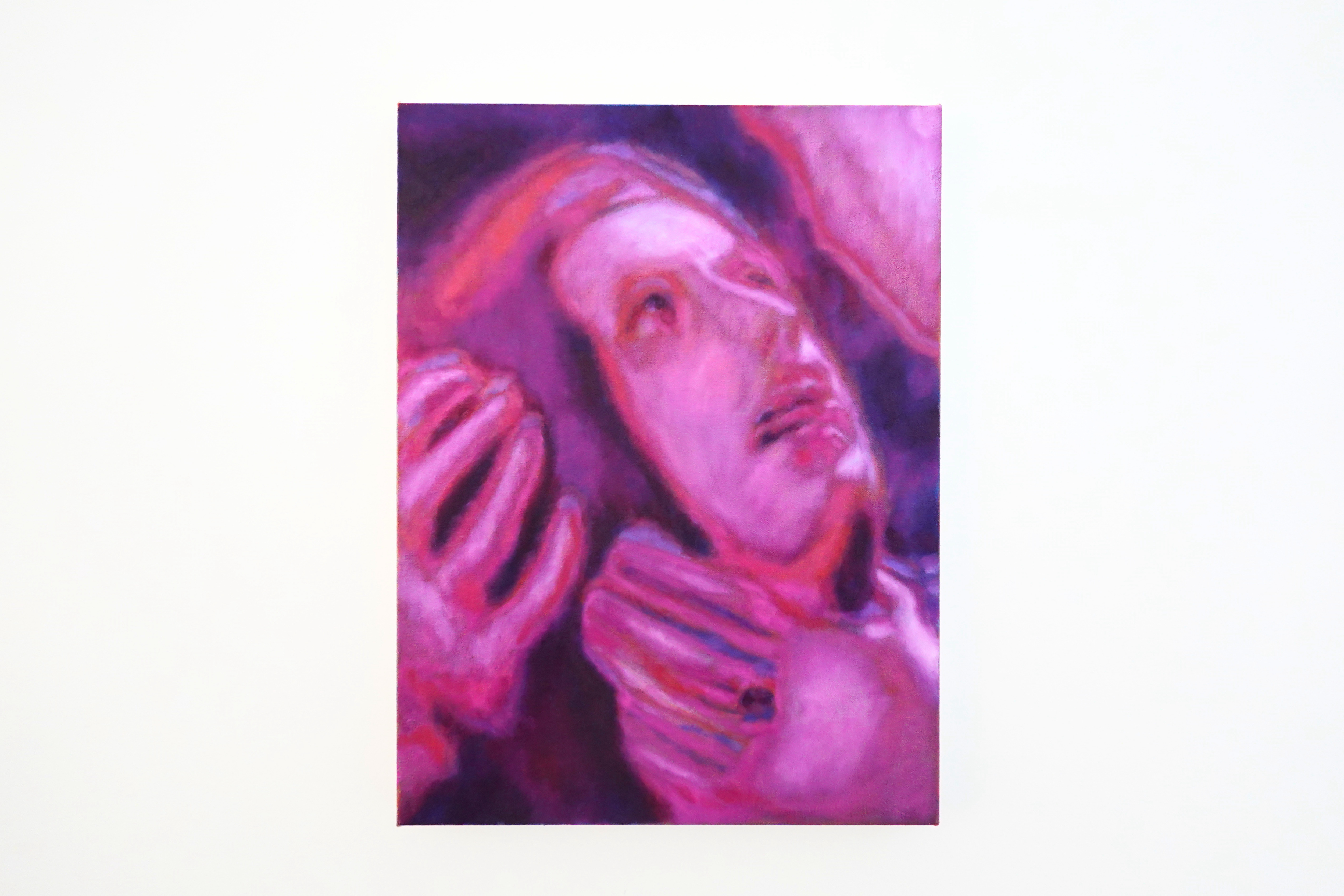
Image | Jacob Kotzee, Leni, 2025, oil on canvas 55 × 40 cm
~
Merging and Dissolving: On Devotion, Spectacle, and Architectures of Belief in House of Ghosts
'Tis mad idolatry To make the service greater than the god.
William Shakespeare, Troilus and Cressida (Act 2, Scene 2)
~
What does it mean to devote oneself. To a nation, to a god, to a memory, to an image? The same gestures that lift hands in prayer can also raise them in salute. Men of stolen virtue can emanate the same light that crowns a heavenly apparition. Reverence is portable. This precarity is where House of Ghosts begins. In a space where belief takes shape through image, ritual, and repetition, and with the knowledge that these forms always bear the weight of what (and who) they serve.
The exhibition explores these architectures of belief. Devotion appears as gesture, choreography, and atmosphere. Water recurs as offering and as witness. Rose-scented inheritance. Ritual ablution. Tropical rain falling over scarred land. Ice surrendering to the sun. The body appears as vessel and as instrument - straining, adorned, masked, dissolving. Architectural fragments become thresholds, performance becomes altar, image becomes relic. If devotion promises transcendence, the works in this exhibition trace its stagings, and what they leave behind.
What remains are ghosts. Not the supernatural kind. Presences and residues. Cultural memory carried in wood and scent. Political violence embedded in landscape and image. Longing and desire crystallised into symbols. These works do not attempt to exorcise what haunts them. Instead, they hold space for it, focusing on the residue, presence, and inevitable afterlife of belief.
Keiran Molaeb,
At the centre of the exhibition, Keiran Molaeb stages a gesture of gathering. An old rug (a family heirloom) anchors the room, with seven cushions arranged in a circle upon it. Visitors are invited to step onto the rug, to sit, to view the surrounding works from this lowered vantage point. The installation asks for stillness and it redistributes hierarchy. Instead of looking at art from a distance, the viewer becomes situated within a shared ground.
Seven is a magic number. Across cosmological traditions, the number recurs as a structuring principle. Seven classical planets visible to the naked eye. Seven days that measure cyclical time. Seven heavens in Islamic cosmology. Seven circuits around the Kaaba during pilgrimage. Seven stages of spiritual ascent in various mystical traditions. The number appears recurrently as ontology, as a way of describing how reality is layered and apprehended.
Keiran’s family is Druze, and this cosmological lineage informs the work directly. Within Druze cosmology, seven articulates the architecture of existence, a metaphysical structure through which divine unity becomes knowable in differentiated form. It names stages of emanation, thresholds of consciousness, an order that binds cosmos and interior life. The number operates as philosophical structure, a way of mapping reality itself. The circle of seven cushions echoes this logic. A geometry of relation that binds the spatial, communal, and metaphysical.
The act of inviting viewers to sit on the rug is one of radical hospitality. In many gallery contexts, the floor is boundary, distance is enforced. Here, the ground becomes shared territory. To sit is to accept vulnerability, to slow down, to occupy the space collectively rather than competitively. The gesture resonates with domestic hospitality traditions across West Asian cultures, where rugs are sites of gathering, conversation, and care. Generosity becomes spatial.
Elsewhere in the exhibition, Keiran presents an assemblage that extends this intimacy. Portraits of his father and grandfather hung like icons above a Lebanese matte tea set, with za’atar, dried roses, and slices of olive and cedar wood. Each painting is rendered on wood sourced from his family in Lebanon, material prepared by hand by his grandfather. Surface and lineage are inseparable.
The wood carries time and its grain becomes biography. The portraits feel less applied than revealed, as though memory were embedded within the timber long before paint touched it. In Lebanese and broader Levantine contexts, olive and cedar signal endurance, sacred narrative, agricultural continuity, attachment to land. They carry histories of cultivation and survival across occupation, war, and diaspora.
Keiran’s practice turns toward storytelling as embodied devotion. Cultural roots stretch across displacement and generational fracture. The tea set and dried herbs evoke everyday ritual - hospitality as daily liturgy. What appears intimate is inseparable from geopolitics. The wood arrives from a region marked by ongoing occupation and war. In this context, care is defiant. Painting becomes a refusal of erasure, a material insistence that lineage persists.
The circle on the rug and the portraits on wood operate together. One gathers the living into temporary community. The other anchors the past within present matter. Seven cushions, seven as cosmological structure, seven as time measured and returned. Devotion here is not a spectacle. It is the long, quiet labour of staying. Of receiving what has been carried across war and water. A welcome that can’t be unmade.
Johanna van der Linden,
Johanna van der Linden’s Deposition Study (Steel) draws from found imagery of US Naval Academy midshipmen climbing a greased obelisk, their bodies slipping and tangling against gravity. Their faces are strained and grimacing. Johanna isolates and crops these moments of collective effort, folding them into compositions that recall Baroque and medieval depictions of Christ’s body being lowered from the cross. Limbs press against one another, torsion accumulates, and the body becomes a site of burden and offering. In these repetitions, gestures of devotion reappear not really as belief. Maybe more as physical necessity? The need to hold, to support, to endure.
This is the Herndon Climb, an annual rite at the US Naval Academy in Annapolis, where first-year midshipmen scale a 21-foot granite obelisk slicked with fifty pounds of vegetable shortening. Their task is to retrieve a plebe's cap at the apex and replace it with an upperclassman's officer cover, symbolically completing the passage from initiate to officer. It is not functional training in any practical sense. It is symbolic, repetitive, and staged. The act tests endurance, discipline, and collective coordination, but it also operates as spectacle. Bodies made to strain, slip, and persevere under observation. In this way, it closely mirrors religious ritual. A codified action repeated over time to produce belief, cohesion, and myth. The grease ensures failure is built into the act. Ascent is never clean or singular.
The US military is not only one of the most ritualised institutions of the modern state, but also a locus of neo-imperial power. Exporting force, ideology, and spectacle across borders under the language of protection, freedom, and order. Its rituals are carefully aestheticised. Uniforms, choreographed movement, symbols of sacrifice, and narratives of heroism designed to naturalise violence and supremacy. By drawing specifically from the US Naval Academy rather than a generic or anonymous military body, Johanna situates the work within a global visual economy shaped by American power, where images of endurance and unity are mobilised to legitimise intervention and control.
Translated into the visual grammar of devotional art, this imagery exposes how nationalist devotion and religious worship often share the same architectures. Demanding belief, disciplining bodies, and producing myths of transcendence through sacrifice. Slowed down, cropped, and re-framed, the spectacle begins to fracture, allowing the vulnerability, violence, and quiet absurdity embedded in these rituals to surface.
Materially, the images are held with and within steel structures that both contain and pierce their surface, marking it with a sense of force. The steel (worked and heavy) introduces labour, heat, and pressure, creating moments that recall stigmata, acting as both extension and interruption of the image. In one iteration the image sits low, requiring the viewer to bend down. In the other, it is elevated above eye level, echoing the bodily posture traditionally assumed before icons. The viewer’s body becomes implicated in the ritual of looking. In many ways, this work asks how images of suffering, labour, and collective endurance continue to function as sites of reverence, and how the body (marked, strained, transformed) remains central to how meaning is made and carried.
Naveed Farro,
Two sculptural plinths by Naveed Farro are each crowned with a recessed form derived from muqarnas - the intricate, three-dimensional, honeycomb-like ornamentation characteristic of Islamic architecture. One recess references the muqarnas vaulting at the entrance to the Shah (Saar) Mosque in Isfahan; the other draws from the sculptural canopy of an Ottoman-era drinking fountain in Istanbul. Dislodged from their contexts, these forms are translated into scaled, intimate structures that sit somewhere between reliquary, model, and memorial fragment.
Historically, muqarnas function as thresholds. They gather and dissolve structure at moments of transition. Between wall and dome, earth and heaven, exterior and interior. Their faceted cells catch and scatter light, producing a sense of infinite subdivision that gestures toward the immaterial. Often described as crystallisations of geometry, muqarnas hold both mathematical precision and metaphysical charge. They are cosmological, staging an encounter between the earthly viewer and a vision of divine order.
By isolating and inverting these forms into recessed surfaces, Naveed shifts the muqarnas from overhead canopy to interior void. The orientation is quietly but decisively reversed. We look down into them rather than up. What once mediated between human and divine now reads as a hollow, an absence, a space held open at hand level. Each cavity contains a shallow pool of rose water. The scent reaches the body before the eye fully registers the form. Smell becomes a mode of address.
Rose water carries a dense sensory and cultural charge across Iranian and broader West and South Asian contexts. It moves easily between the domestic, the devotional, and the ceremonial: used in sweets and tea, in hospitality rituals, in washing the hands of guests, in perfuming mosques, shrines, and the bodies of the dead. It is everyday and it is also sacred. Its presence here activates memory through atmosphere, conjuring embodied forms of belonging. The recessed muqarnas thus hold an offering. Scent as inheritance, liquid as mnemonic trace.
This sensory register folds into the work’s reference to an Ottoman drinking fountain. In Islamic architectural traditions, fountains exceed their civic function. They are sites where water, charity, and spirituality converge. Water purifies before prayer, evokes the gardens of paradise in Qur’anic imagery, and sustains life as divine provision. Historically, public fountains functioned as acts of ongoing charity (sadaqah jariyah), where the gift of water extended devotion into the social realm. By invoking the sculptural language of these fountains (and by filling his forms with scented liquid) Naveed draws attention to water as a medium of both bodily and spiritual sustenance, an element that moves between survival and grace.
Naveed’s engagement with these forms is mediated by distance. As a second-generation Iranian-Australian, his access to the architectural sites that inform this work is shaped by geopolitical realities. The mosques, fountains, and monuments he references are not easily available to him as lived, embodied spaces. Instead, they are often encountered through photographs, scans, digital archives, and dispersed visual records. Imaging technologies become tools of reconstruction and return. Ways of touching what cannot be physically visited. This technological mediation is a condition of contemporary diasporic inheritance, where cultural memory is often assembled through screens, fragments, and partial views, and where return, when it is possible, takes the form of a very long journey.
In the exhibition these plinths read as devotional objects for a displaced gaze. They hold the trace of architectural traditions that exceed the gallery while acknowledging the fractures that shape their transmission. Like other works in the exhibition, they operate through gestures of offering and reinvention. Not the replication of heritage, but its careful rearticulation. Placed among works that treat the body as vessel, image as relic, and material as carrier of lineage, Naveed’s sculptures extend the exhibition’s exploration of devotion into the terrain of mediated memory. Here, the sacred is neither fixed nor fully recoverable. It appears instead as a patterned echo, a geometry of absence, a space shaped by what cannot be returned to except through acts of translation.
Alexandra Kumala,
Alexandra Kumala’s films establish a visual and conceptual dialogue with Naveed’s sculptures opposite. Where his works hold scent and geometry in contained, intimate forms, Alexandra’s moving images flood the space with colour, ritual gesture, and sublime imagery.
Her first film, Ita (The Prayer), is a nonlinear fiction work that draws on experimental language, metaphor, and symbolic excess to speak about intimate violence as inseparable from political violence. It opens with a close-up of hands being washed, a tactile gesture that gradually reveals itself as ritual ablution within a mosque. Water frames the film from its outset. This image cuts to a woman at church dipping her fingers into an octagonal baptismal font, its inner surfaces inscribed with the words “and” “wash” “away”. The form is old Christian iconography. Eight sides for the eighth day, the day of resurrection, baptism as crossing from one life into another. Purification here is physical, spiritual, and psychological. These sacred liquids echo the rose water held in Naveed's sculptures across the gallery, creating a sensory rhyme between the works.
Almost immediately the film shifts again. A hand pours milk over a Shiva Lingam, the aniconic form through which the Hindu god Shiva is venerated. The gesture belongs to abhisheka, a ritual bathing of the deity performed with milk, water, honey, or oils. Soon after, rose petals and water cascade over a golden Buddha. Though the religious traditions differ, the gestures resonate. Liquids flow across surfaces in a repetitive rhythm, producing a visual grammar of devotion that moves fluidly across faiths.
The film follows a woman moving through multiple sites of worship. Mosques, temples, shrines, churches. Her hands frequently clasped in prayer, incense burning, offerings arranged. Alexandra lingers on luminous details. Fairy lights glitter across temple interiors, saturated colours bloom across the frame, ritual objects shimmer under devotional illumination. Yet these sacred spaces are not presented as stable refuges. Instead they appear as charged aesthetic environments where spectacle, submission, beauty, and authority converge.
This ambiguity is central to the work. Ita is not devout but agnostic, reflecting a reality many young Indonesians privately recognise but cannot publicly express. In Indonesia, religion is legally mandated, and only six faiths are formally recognised by the state. The hundreds of Indigenous belief systems practised across the archipelago remain outside this framework.(1) Ita moves through these sanctioned religions as someone compelled to perform belief. For Ita, devotion is both a search for transcendence and an exposure to surveillance. Carried by a voice-over addressed to an ambiguous “God”, the film unfolds as confession and plea. Through the perspective of a Tionghoa-Peranakan woman navigating Indonesia’s complex political and religious terrain, Ita (The Prayer) reclaims prayer as a fragile space for articulating what cannot safely be spoken elsewhere. Ritual becomes a container for grief, endurance, and suppressed rage.
Immediately following Ita (The Prayer), Notes from Silences shifts from staged symbolic fiction into an experimental documentary mode while continuing Alexandra’s inquiry into what cannot be safely said. If Ita locates silence within the interior life of prayer, Notes from Silences disperses it across landscape, atmosphere, and the everyday.
Composed from personal archival material (handycam and phone footage, analogue photographs, voice notes, and ambient field recordings gathered during research), the film assembles a fractured meditation on collective memory and the difficulty of representing political violence. It moves between Bali and Vieques, two islands separated by oceans yet bound by a shared visual grammar. Lush vegetation, radiant water, and postcard horizons evoke the seductive image of tropical paradise. Yet both places carry long histories of military presence, imperial intervention, and unresolved violence.(2)
Scenes of apparent banality unfold. Laundry moving in the wind, someone cooking in a kitchen, drifting clouds seen from an airplane window, the view from a passing car. Rain falls in dense sheets, gathers in puddles, and moves through jungle and storm. Water returns as a recurring element, though here it appears as atmospheric witness. Sky, sea, humidity, and downpour hold histories that resist narration.
Originally conceived as a project grounded in recorded testimony, the film changed direction when many of the people Alexandra spoke with in Bali and Vieques hesitated to go on record. Stories remained too painful, too dangerous, or too politically fraught to tell publicly. In response, Notes from Silences turns toward what exceeds human speech. Wind in trees, insects, waves, and shifting weather become nonhuman witnesses, presences that endure when official histories are suppressed or revised. Silence here is pressure (not absence), a resonance held within land and climate when language withdraws.
Notes from Silences extends the exhibition’s exploration of devotion into the terrain of memory and erasure. If other works in the exhibition approach the sacred through ritual gesture, inherited objects, or architectural forms, Alexandra approaches it through attention. To fragments, atmospheres, and the persistence of place. Beaches, jungle, and glistening light (paradise) are revealed as fragile surfaces stretched over unresolved histories.
Across both films, devotion dissolves into something more complex. A shimmering negotiation between belief, doubt, memory and silence. Alexandra invites us to linger in that unstable space where prayer becomes both survival strategy and political gesture, and where the landscapes we imagine as idyllic continue to hold the ghosts of what has been buried within them.
(1) The six religions formally recognised under Indonesian law are Islam, Protestantism, Catholicism, Hinduism, Buddhism, and Confucianism, each registered on the national identification card (KTP). A 2017 Constitutional Court ruling permitted adherents of Indigenous belief systems (Aliran Kepercayaan / Penghayat Kepercayaan) to register their faith as a separate category, though this designation remains unequal in practice and is widely contested by Indigenous communities and scholars.
(2) Vieques, a small island municipality of Puerto Rico, was used by the United States Navy as a bombing range and military training site from 1941 until 2003, when sustained mass protests, following the death of a Puerto Rican civilian during exercises in 1999, led to the Navy's withdrawal. Decades of bombardment left widespread environmental contamination and elevated rates of illness among the island's residents. Bali was a major site of the 1965-66 Indonesian mass killings, in which an estimated 500,000 to one million people were murdered across the archipelago in anti-communist purges following the abortive 30 September Movement. On Bali alone, the death toll is estimated at approximately 80,000. Neither history is named directly in Notes from Silences, but both shape the field of unspoken pressure that the film attends to.
Devika Bilimoria,
Devika Bilimoria’s video Short-Throat (2025) turns toward the melting body as both image and event. Shot in close-up from the waist up, the work is installed slightly above eye level, the body rendered just larger than life. Viewers find themselves looking upward at Devika, a subtle theatrical framing that amplifies the sense of display. The body becomes image, staged and slightly monumental. In this position, indulgence is very much performed. Sensation becomes the spectacle. The camera fixes on Devika standing outdoors beneath an unforgiving sun. They slowly eat an iced lolly, their face illuminated by harsh daylight. The gesture is simple, almost banal. Yet stretched into duration, the act begins to accumulate intensity. What first appears casual becomes a study in heat, exposure, pleasure, and the body’s negotiation with climate.
The ice block steadily collapses, softening and dripping as time passes. What begins as a brightly coloured, pleasurable object becomes unstable matter, slipping from solid to liquid. The sun bears down, the body persists, and the frozen sweetness transforms into a slow, sticky offering to gravity and air. Like the rose water held in Naveed’s recessed forms, liquid here becomes a carrier of sensation and time. Not contained, but actively undoing its own shape. Melting reads as erotic and environmental. Time thickens around the slow undoing of form.
When we were initially planning this exhibition, we spoke about Notes on 'Camp' (1964) by Susan Sontag, and through this Devika described this work as an exploration of how durational performance might operate as a form of camp.(3) Unlike Sontag's examples however, camp here does not appear primarily as irony or parody. It emerges instead through stylisation and excess. The performance treats a small, fleeting act with a kind of exaggerated commitment. The gesture becomes theatrical in its intensity, and almost devotional in its repetition. Time feels staged, stretched, and made viscous as the body lingers in sensations. Sweetness, heat, stickiness, exposure. In this way the work echoes Sontag's description of camp as a form of seriousness that exceeds itself. A trivial object is held within the gravity of a small ritual. Pleasure becomes the spectacle. The body performs indulgence slowly, deliberately, and seems defiantly unserious in the face of urgency.
Also thinking with philosopher Elizabeth Grosz, Devika approaches the body as a field of forces and sensations, and Short-Throat attends to what happens between all of this.(4) Between sun and skin, ice and mouth, sweetness and discomfort, camera and performer. These exchanges operate less as symbols than as affective events - melting as communication, heat as touch, duration as pressure. The work stages an intimacy between body and climate that suggests that (the) environment is a co-author of experience. In this sense, queerness emerges as a mode of relation as much as an identity. Porous, excessive, attuned to sensation, and open to transformation.
Short-Throat introduces a different form of offering to the exhibition. Not prayer, object, or inherited material, but attention held across time. The body given over to heat. The slow surrender of form as ice dissolves into syrup, liquid, and memory. What remains is a luminous meditation on becoming in a warming world, where sweetness melts faster than we expect, and where the body must continually renegotiate its place within an increasingly volatile climate.
(3) Susan Sontag, "Notes on 'Camp'," Partisan Review 31, no. 4 (Fall 1964): 515-530. Reprinted in Against Interpretation and Other Essays (New York: Farrar, Straus and Giroux, 1966). Sontag's essay attempted to articulate the sensibility she called camp through fifty-eight numbered notes, identifying it as a mode of aestheticism that "converts the serious into the frivolous" and locates beauty in artifice, theatricality, and failed seriousness.
(4) Grosz's framing of the body as a field of forces, sensations, and intensities is developed across her work, most notably in Volatile Bodies: Toward a Corporeal Feminism (Bloomington: Indiana University Press, 1994).
Thang Do,
It would be impossible to invoke camp without turning to Thang Do’s radiant, oversized fans - titled Harper’s and Bazaar. Now resting on the gallery floors as sculptural remnants, they carry the afterimage of a performance that occurred on opening night, lingering like shed wings or ceremonial regalia set down after use.
Midway through the crowded opening, music began to emanate from a PA system tucked into the office alcove. The shift in collective energy was subtle at first - something is about to happen. Then Thang appeared from an alley across the street. He was dressed head to toe in flowing black, his head encased in a couture-like full-face balaclava with no eye holes, the fabric clinging tightly to the contours of his face. Silver earrings pierced visibly through the cloth into the ears beneath. Masked and adorned, anonymous and hyper-present, this figure read as an apparition. An angel in the gallery.
In each hand, Thang carried a monumental fan. Slowly crossing the street, he approached the gallery. Once inside, the fans caught the light of the projectors - crushed foil, metal leaf, and epoxy surfaces refracting the glow into a restless field of sparkle. Held wide, they read unmistakably as wings. Glamorous, excessive, and slightly unwieldy. Thang moved them up and down in a slow, sustained choreography. The procession was deliberate and unhurried, a movement of body and object tracing arcs through space. The fans themselves became instruments of transformation, mediating between the terrestrial and the sublime, the ordinary materials and their transcendent shimmer.
As in Devika's film, camp here is closer to aesthetic devotion than to parody. The titles Harper’s and Bazaar wink toward the glossy excess of fashion and lifestyle media, invoking worlds of aspiration, fantasy, and constructed glamour. Yet these shining surfaces are built from humble, everyday materials (foil, board, adhesive), echoing Thang’s ongoing use of domestic and disposable materials to construct altar-like forms. The fans become portable monuments to desire. Objects that stage a negotiation with visibility, belonging, and transformation. Camp often thrives on this tension - cheap materials producing extravagant effects, the ordinary leveraged into the spectacular.
Thang Do, a queer Vietnamese-born artist based in Melbourne, often explores spectacle as a vehicle for hope, escape, and self-fashioning. His practice moves between performance and installation, drawing on the emotional textures of diasporic life and the pressures of bureaucratic systems that shape who can move, stay, or belong. In this context, the wing-like fans feel both celebratory and defensive. Shields, costumes, and icons of becoming all at once. They shimmer with promise while revealing the labour of holding oneself aloft.
The fans, and Thang’s body, also enact a form of metamorphosis. Angels in many traditions serve as intermediaries between mortal and divine realms, their forms are mutable, shifting according to purpose or perception. Here, Thang’s wings and balaclava render him neither entirely human nor entirely object. He is simultaneously performer, sculpture, and vision. His black-clad body dissolves into abstraction, leaving only the radiant extension of the fans to register in space. The balaclava complicates the act of looking. Unlike Devika’s Short-Throat, where exposure invites a gaze, here the body resists, refracts, and redirects attention, offering presence without specificity. The viewer confronts a suspended transformation in which the ordinary is transfigured into the extraordinary, if only for a fleeting moment.
Through the performance, Thang stages a ritual of becoming. The fans, the body, and the choreography operate as a sequence of gestures in which devotion is not directed outward toward deity or institution but inward, toward self-fashioning, endurance, and luminous emergence. The metamorphic quality of the work underscores the exhibition’s interest in devotion, visibility, and inheritance. Belief, care, and spectacle are enacted in objects or architecture, and also in the ephemeral choreography of presence itself.
Maki Ogawa,
Across the back gallery wall, and extending outward onto the public-facing window, Maki Ogawa’s drawing series Internal Dialogues presents a constellation of symbols, fragments, and visual echoes. The work comprises 21 small drawings on gridded paper, each holding a sparse arrangement of motifs. A two-headed deity or genie-like silhouette rising like smoke from a vessel, a mountain, a cloud, knots and lengths of rope, stars, stairs, mesh, and other elemental forms. Some of these images reappear enlarged as vinyl interventions on the gallery window, allowing the interior “thoughts” of the drawings to drift into the public realm. Fragments of an inner landscape made momentarily visible.
Maki, a Japanese-Australian artist based in Eora (Sydney), often reflects on the shifting terrain of bicultural identity. In Internal Dialogues, drawing becomes a form of internal mapping. A way to trace the nonlinear, often contradictory movements of thought that accompany living between cultural frameworks. Each image appears discrete, even unrelated, yet a subtle visual logic threads through the series. Forms morph, echo, or translate across drawings. A curve becomes a cloud, a line becomes rope, a peak becomes a stair. Meaning is never fixed here. Instead, it drifts, recombines, and reforms, like language still in the process of becoming.
Running through the series is a patient affinity with older, proto-forms of meaning-making. Symbols that feel as though they might have been scratched into stone, woven into textiles, or carved into walls. The drawings evoke the fragmentary logic of ruins - partial signs whose original context is lost, yet whose presence is still deeply charged. A knot becomes practical binding and talismanic mark. A stair suggests ascent but also the impossibility of reaching a complete structure. A star reads as navigation and as distant, unreachable light. These are images that hover between diagram and relic, as though retrieved from an internal archaeology.
The graph paper is central to this tension. For Maki, it recalls childhood exercises in Japanese language learning, the squared sheets of genkō yōshi paper used to practice kanji one character to a square. A tool of discipline, repetition, and translation. Here, the grid becomes an “internal grid,” a psychological architecture against which these drifting symbols gather. Like ruins mapped onto a surveyor’s plan, the drawings sit between structure and subconscious residue. The sacred and the mundane coexist in the same marks. Everyday objects that double as spiritual or mythic signs.
Maki’s drawings offer a different register of devotion in the exhibition. One rooted in attention, memory, and the slow accumulation of signs. If other works in the exhibition approach the sacred through ritual, architecture, or embodied performance, Internal Dialogues stages the mind itself as a site of excavation. The drawings feel like thoughts trying to assemble meaning from fragments, never fully resolving. In that suspended state Maki locates a quiet beauty. A devotional attention to the fragile, fragmentary process through which identity and meaning are continually made and remade.
Jacob Kotzee,
Jacob Kotzee’s paintings enter the exhibition through a different but resonant threshold - the haunted afterlife of images. Working from film stills, archival material, and the visual language of early devotional painting, Jacob examines how aesthetic traditions tied to transcendence, folklore, and spiritual longing can be mobilised toward ideological ends.
This body of work centres on Leni Riefenstahl’s 1932 film Das blaue Licht (The Blue Light), approached as an early site where landscape, myth, and ideas of 'purity' converge into a visual language later absorbed into the aesthetic machinery of fascism. The film was Riefenstahl's directorial debut, and its visual style is widely understood as what brought her to the attention of Hitler, who would commission Triumph of the Will (1935) and Olympia (1938) shortly thereafter. In the film, Riefenstahl plays Junta, an outcast in a Dolomite mountain village who is reviled by the locals as a witch. Junta alone can scale Monte Cristallo to reach a hidden grotto where, on full-moon nights, light passes through a fissure in the rock and ignites a chamber of crystals into a sacred blue glow. These romanticised landscapes draw on longer traditions of German Romantic nationalism, where nature becomes a stage for mythic belonging and spiritual destiny. Jacob reads this imagery as a precursor to the cinematic techniques Riefenstahl would later deploy in service of Nazi propaganda. Beauty, spectacle, and idealised bodies were mobilised to aestheticise racial ideology and legitimise totalitarian power, helping to normalise the machinery of persecution, dispossession, and industrialised genocide.
The individual paintings in the exhibition draw these historical currents into intimate, unsettling encounters. Leni presents a portrait of Leni Riefenstahl rendered in bruised tones of magenta, plum, and violet. Her softened and blurred features are unsettled and somewhat grotesque. A hand appears to grip at her throat, her mouth open, tongue visible - a scene unmoored from clear narrative and curdled into something spectral and abject. Hung beside it, Noose isolates a length of rope arranged into the unmistakable loop of capital punishment, a phrase where bureaucratic neutrality thinly veils its reality - state-sanctioned killing. This slippage between sanitised language and brutal reality recalls the rhetorical strategies through which the Nazi regime obscured and administered mass murder. It also resonates with contemporary political vocabularies, where phrases like "ethnic cleansing" wrap the systematic and usually violent removal of ethnic, racial, or religious groups in the soft language of tidying or purification. Such euphemisms dull the violence they describe and help normalise policies that approach genocide. In Jacob’s painting, the rope glows against a dark ground, rendered like a scatter of stars across a night sky or pearls suspended in velvet. The aestheticisation produces a sinister incongruity - an instrument of execution made seductive, celestial, almost devotional. Within the exhibition, the rope echoes the knots and cords that recur in Maki Ogawa’s drawings and window works, but here the associative field shifts from connection and navigation to punishment and death. Paired together, Leni and Noose suggest a feedback loop between image and instrument, where the seduction of beauty and perfection is made in service of violence.
Elsewhere in the gallery, a long horizontal painting depicts a figure nearly obliterated by light - Angel. The body appears blurred, suspended, dissolving into an atmosphere of deep forest greens and purples. Stylistically akin to Noose, the image feels transcendent, recalling mystical rapture and the visual rhetoric of ascension so often mobilised in religious and nationalist iconography. Above the bookshelf, another elongated canvas shows a cluster of upturned hands emerging from a saturated purple field. The gesture reads as ecstatic. Arms raised in worship, surrender, or collective euphoria. It could be a congregation in prayer, but just as easily a crowd at a rave or nightclub, bodies losing themselves in rhythm and light. Across these works, Jacob lingers in the unstable space where transcendence tips into disappearance, where devotion, spectacle, and collective fervour share the same visual grammar, and where beauty’s glow risks obscuring the structures of power that choreograph it.
This line of inquiry resonates with Susan Sontag’s landmark essay Fascinating Fascism (1975), written during a period when efforts were underway to rehabilitate Riefenstahl’s image as a purely formal “artist”.(5) Sontag insisted that such separation was untenable. Riefenstahl's work did not just borrow fascist themes. It helped construct the visual grammar of 20th-century European fascism itself. She identified recurring aesthetic devices (the worship of physical perfection, the choreography of massed bodies, the eroticisation of submission, the staging of ecstasy through discipline, and the transformation of politics into spectacle) as central to the fascist imaginary. These mechanisms are not so distant from those found in religious or devotional art, which also mobilise light, elevation, repetition, and idealised bodies to evoke transcendence and collective belief. The difference is not in the formal tools, but in the ideological ends to which they are directed.
Across the series, Jacob probes the intimacy between visual pleasure and political power. By reworking Riefenstahl's imagery through the slow, tactile labour of painting, he interrupts the seamless seduction of the cinematic image and opens space for its ideological undercurrents to surface. Placed within the visual syntax of icons and altarpieces, the paintings draw attention to how easily aesthetics of worship can sanctify power, and how images can function as instruments of collective myth-making. They brush against the terrain of cult aesthetics, where charisma, spectacle, and ritualised imagery bind viewers into affective alignment, asking how transcendence is pictured, how beauty persuades, and how visual codes of purity, belonging, and sanctity continue to echo through Western cultural memory long after their origins are obscured.
At stake here is the broader power of images themselves. Images do not just reflect the world, they participate in structuring how it is perceived and therefore how it is lived. As critical media theorists have long argued, representation does not stand outside ideology but actively produces it. The image trains the eye, shapes desire, rehearses belief. It naturalises what is constructed, renders myth as inevitability, and makes certain futures feel ordained. Fascist aesthetics did not simply decorate a political project. They helped make that project imaginable, desirable, and emotionally coherent.(6)
Jacob's paintings slow this process down. By collapsing cinematic depth into flattened, icon-like surfaces, he exposes the scaffolding of transcendence, inviting us to consider how easily we are moved by spectacle, how readily we mistake luminosity for virtue. In a culture saturated with images (algorithmically circulated, endlessly reproduced), this question feels urgent. What do we consent to when we are seduced by a surface? What ideologies are smuggled through pleasure? How might we learn to see not only what images show, but what they do? In this exhibition, where vessels, rituals, bodies, and symbols circulate across the space, Jacob's paintings function as a cautionary hinge. They remind us that devotion is never free of allegiance, that reverence can be weaponised, and that images (luminous, transcendent, unforgettable) have the capacity to build the worlds in which belief takes hold.
(5) Susan Sontag, "Fascinating Fascism," The New York Review of Books (6 February 1975), reprinted in Under the Sign of Saturn (New York: Farrar, Straus and Giroux, 1980). The essay was provoked by the rehabilitation of Riefenstahl's reputation in the early 1970s, particularly the publication of her photographs of the Nuba people of Sudan, which were being promoted as evidence of a purely aesthetic vision detached from her Nazi past.
(6) This conceptual lineage runs back to Walter Benjamin's formulation, in the epilogue to "The Work of Art in the Age of Mechanical Reproduction" (1936), that fascism is the aestheticisation of political life. Benjamin's claim sits underneath Sontag's argument in Fascinating Fascism (see note 2), and underneath this essay's reading of devotional aesthetics as a structure that can be mobilised toward radically different ends.
~
House of Ghosts holds these registers of devotion together without resolving them. Across the exhibition, belief appears as many different things - inheritance, instrument, offering, discipline, labour, and luminous performance. The works do not choose between these forms. They sit alongside one another, attentive to the residues each one leaves behind, speaking to each other across the room. What gathers in the space are the conditions under which transcendence is staged, the inheritances it carries, and the costs it accumulates. The ghosts are still here. They have been given somewhere to rest.
- Lucie Loy
In Celtic cosmology, sacred groves were living thresholds. They weren’t places you climbed upward toward the divine or descended downward into an eternal inferno. Instead, they were understood as side-doors. Quiet openings into a world that ran parallel to ours. The Otherworld wasn’t imagined as heaven or underworld; it was just beside us, touching our world at certain edges. These spaces acted as sanctuaries, courts, ritual sites, and portals for encounter and communion. But they weren’t monumental. They were earthly spaces - of roots, soil, leaves, air. The sacred was encountered through the texture of the world itself.
This idea (that the spiritual lives alongside us, not above us) also moves through this exhibition. House of Ghosts presents a vision of the sacred that is grounded, bodily, sensory. Together, the artists explore the psychic, spatial, and somatic registers of contemporary devotion. Their works stay close to the earthly plane, asking how faith, ritual, and devotion function here, now, in the messy, hybrid, highly mediated present. A sanctuary not of ascension but of coexistence. A world overlapping ours.
Image | Jacob Kotzee, Leni, 2025, oil on canvas 55 × 40 cm
~
Merging and Dissolving: On Devotion, Spectacle, and Architectures of Belief in House of Ghosts
'Tis mad idolatry To make the service greater than the god.
William Shakespeare, Troilus and Cressida (Act 2, Scene 2)
~
What does it mean to devote oneself. To a nation, to a god, to a memory, to an image? The same gestures that lift hands in prayer can also raise them in salute. Men of stolen virtue can emanate the same light that crowns a heavenly apparition. Reverence is portable. This precarity is where House of Ghosts begins. In a space where belief takes shape through image, ritual, and repetition, and with the knowledge that these forms always bear the weight of what (and who) they serve.
The exhibition explores these architectures of belief. Devotion appears as gesture, choreography, and atmosphere. Water recurs as offering and as witness. Rose-scented inheritance. Ritual ablution. Tropical rain falling over scarred land. Ice surrendering to the sun. The body appears as vessel and as instrument - straining, adorned, masked, dissolving. Architectural fragments become thresholds, performance becomes altar, image becomes relic. If devotion promises transcendence, the works in this exhibition trace its stagings, and what they leave behind.
What remains are ghosts. Not the supernatural kind. Presences and residues. Cultural memory carried in wood and scent. Political violence embedded in landscape and image. Longing and desire crystallised into symbols. These works do not attempt to exorcise what haunts them. Instead, they hold space for it, focusing on the residue, presence, and inevitable afterlife of belief.
Keiran Molaeb,
At the centre of the exhibition, Keiran Molaeb stages a gesture of gathering. An old rug (a family heirloom) anchors the room, with seven cushions arranged in a circle upon it. Visitors are invited to step onto the rug, to sit, to view the surrounding works from this lowered vantage point. The installation asks for stillness and it redistributes hierarchy. Instead of looking at art from a distance, the viewer becomes situated within a shared ground.
Seven is a magic number. Across cosmological traditions, the number recurs as a structuring principle. Seven classical planets visible to the naked eye. Seven days that measure cyclical time. Seven heavens in Islamic cosmology. Seven circuits around the Kaaba during pilgrimage. Seven stages of spiritual ascent in various mystical traditions. The number appears recurrently as ontology, as a way of describing how reality is layered and apprehended.
Keiran’s family is Druze, and this cosmological lineage informs the work directly. Within Druze cosmology, seven articulates the architecture of existence, a metaphysical structure through which divine unity becomes knowable in differentiated form. It names stages of emanation, thresholds of consciousness, an order that binds cosmos and interior life. The number operates as philosophical structure, a way of mapping reality itself. The circle of seven cushions echoes this logic. A geometry of relation that binds the spatial, communal, and metaphysical.
The act of inviting viewers to sit on the rug is one of radical hospitality. In many gallery contexts, the floor is boundary, distance is enforced. Here, the ground becomes shared territory. To sit is to accept vulnerability, to slow down, to occupy the space collectively rather than competitively. The gesture resonates with domestic hospitality traditions across West Asian cultures, where rugs are sites of gathering, conversation, and care. Generosity becomes spatial.
Elsewhere in the exhibition, Keiran presents an assemblage that extends this intimacy. Portraits of his father and grandfather hung like icons above a Lebanese matte tea set, with za’atar, dried roses, and slices of olive and cedar wood. Each painting is rendered on wood sourced from his family in Lebanon, material prepared by hand by his grandfather. Surface and lineage are inseparable.
The wood carries time and its grain becomes biography. The portraits feel less applied than revealed, as though memory were embedded within the timber long before paint touched it. In Lebanese and broader Levantine contexts, olive and cedar signal endurance, sacred narrative, agricultural continuity, attachment to land. They carry histories of cultivation and survival across occupation, war, and diaspora.
Keiran’s practice turns toward storytelling as embodied devotion. Cultural roots stretch across displacement and generational fracture. The tea set and dried herbs evoke everyday ritual - hospitality as daily liturgy. What appears intimate is inseparable from geopolitics. The wood arrives from a region marked by ongoing occupation and war. In this context, care is defiant. Painting becomes a refusal of erasure, a material insistence that lineage persists.
The circle on the rug and the portraits on wood operate together. One gathers the living into temporary community. The other anchors the past within present matter. Seven cushions, seven as cosmological structure, seven as time measured and returned. Devotion here is not a spectacle. It is the long, quiet labour of staying. Of receiving what has been carried across war and water. A welcome that can’t be unmade.
Johanna van der Linden,
Johanna van der Linden’s Deposition Study (Steel) draws from found imagery of US Naval Academy midshipmen climbing a greased obelisk, their bodies slipping and tangling against gravity. Their faces are strained and grimacing. Johanna isolates and crops these moments of collective effort, folding them into compositions that recall Baroque and medieval depictions of Christ’s body being lowered from the cross. Limbs press against one another, torsion accumulates, and the body becomes a site of burden and offering. In these repetitions, gestures of devotion reappear not really as belief. Maybe more as physical necessity? The need to hold, to support, to endure.
This is the Herndon Climb, an annual rite at the US Naval Academy in Annapolis, where first-year midshipmen scale a 21-foot granite obelisk slicked with fifty pounds of vegetable shortening. Their task is to retrieve a plebe's cap at the apex and replace it with an upperclassman's officer cover, symbolically completing the passage from initiate to officer. It is not functional training in any practical sense. It is symbolic, repetitive, and staged. The act tests endurance, discipline, and collective coordination, but it also operates as spectacle. Bodies made to strain, slip, and persevere under observation. In this way, it closely mirrors religious ritual. A codified action repeated over time to produce belief, cohesion, and myth. The grease ensures failure is built into the act. Ascent is never clean or singular.
The US military is not only one of the most ritualised institutions of the modern state, but also a locus of neo-imperial power. Exporting force, ideology, and spectacle across borders under the language of protection, freedom, and order. Its rituals are carefully aestheticised. Uniforms, choreographed movement, symbols of sacrifice, and narratives of heroism designed to naturalise violence and supremacy. By drawing specifically from the US Naval Academy rather than a generic or anonymous military body, Johanna situates the work within a global visual economy shaped by American power, where images of endurance and unity are mobilised to legitimise intervention and control.
Translated into the visual grammar of devotional art, this imagery exposes how nationalist devotion and religious worship often share the same architectures. Demanding belief, disciplining bodies, and producing myths of transcendence through sacrifice. Slowed down, cropped, and re-framed, the spectacle begins to fracture, allowing the vulnerability, violence, and quiet absurdity embedded in these rituals to surface.
Materially, the images are held with and within steel structures that both contain and pierce their surface, marking it with a sense of force. The steel (worked and heavy) introduces labour, heat, and pressure, creating moments that recall stigmata, acting as both extension and interruption of the image. In one iteration the image sits low, requiring the viewer to bend down. In the other, it is elevated above eye level, echoing the bodily posture traditionally assumed before icons. The viewer’s body becomes implicated in the ritual of looking. In many ways, this work asks how images of suffering, labour, and collective endurance continue to function as sites of reverence, and how the body (marked, strained, transformed) remains central to how meaning is made and carried.
Naveed Farro,
Two sculptural plinths by Naveed Farro are each crowned with a recessed form derived from muqarnas - the intricate, three-dimensional, honeycomb-like ornamentation characteristic of Islamic architecture. One recess references the muqarnas vaulting at the entrance to the Shah (Saar) Mosque in Isfahan; the other draws from the sculptural canopy of an Ottoman-era drinking fountain in Istanbul. Dislodged from their contexts, these forms are translated into scaled, intimate structures that sit somewhere between reliquary, model, and memorial fragment.
Historically, muqarnas function as thresholds. They gather and dissolve structure at moments of transition. Between wall and dome, earth and heaven, exterior and interior. Their faceted cells catch and scatter light, producing a sense of infinite subdivision that gestures toward the immaterial. Often described as crystallisations of geometry, muqarnas hold both mathematical precision and metaphysical charge. They are cosmological, staging an encounter between the earthly viewer and a vision of divine order.
By isolating and inverting these forms into recessed surfaces, Naveed shifts the muqarnas from overhead canopy to interior void. The orientation is quietly but decisively reversed. We look down into them rather than up. What once mediated between human and divine now reads as a hollow, an absence, a space held open at hand level. Each cavity contains a shallow pool of rose water. The scent reaches the body before the eye fully registers the form. Smell becomes a mode of address.
Rose water carries a dense sensory and cultural charge across Iranian and broader West and South Asian contexts. It moves easily between the domestic, the devotional, and the ceremonial: used in sweets and tea, in hospitality rituals, in washing the hands of guests, in perfuming mosques, shrines, and the bodies of the dead. It is everyday and it is also sacred. Its presence here activates memory through atmosphere, conjuring embodied forms of belonging. The recessed muqarnas thus hold an offering. Scent as inheritance, liquid as mnemonic trace.
This sensory register folds into the work’s reference to an Ottoman drinking fountain. In Islamic architectural traditions, fountains exceed their civic function. They are sites where water, charity, and spirituality converge. Water purifies before prayer, evokes the gardens of paradise in Qur’anic imagery, and sustains life as divine provision. Historically, public fountains functioned as acts of ongoing charity (sadaqah jariyah), where the gift of water extended devotion into the social realm. By invoking the sculptural language of these fountains (and by filling his forms with scented liquid) Naveed draws attention to water as a medium of both bodily and spiritual sustenance, an element that moves between survival and grace.
Naveed’s engagement with these forms is mediated by distance. As a second-generation Iranian-Australian, his access to the architectural sites that inform this work is shaped by geopolitical realities. The mosques, fountains, and monuments he references are not easily available to him as lived, embodied spaces. Instead, they are often encountered through photographs, scans, digital archives, and dispersed visual records. Imaging technologies become tools of reconstruction and return. Ways of touching what cannot be physically visited. This technological mediation is a condition of contemporary diasporic inheritance, where cultural memory is often assembled through screens, fragments, and partial views, and where return, when it is possible, takes the form of a very long journey.
In the exhibition these plinths read as devotional objects for a displaced gaze. They hold the trace of architectural traditions that exceed the gallery while acknowledging the fractures that shape their transmission. Like other works in the exhibition, they operate through gestures of offering and reinvention. Not the replication of heritage, but its careful rearticulation. Placed among works that treat the body as vessel, image as relic, and material as carrier of lineage, Naveed’s sculptures extend the exhibition’s exploration of devotion into the terrain of mediated memory. Here, the sacred is neither fixed nor fully recoverable. It appears instead as a patterned echo, a geometry of absence, a space shaped by what cannot be returned to except through acts of translation.
Alexandra Kumala,
Alexandra Kumala’s films establish a visual and conceptual dialogue with Naveed’s sculptures opposite. Where his works hold scent and geometry in contained, intimate forms, Alexandra’s moving images flood the space with colour, ritual gesture, and sublime imagery.
Her first film, Ita (The Prayer), is a nonlinear fiction work that draws on experimental language, metaphor, and symbolic excess to speak about intimate violence as inseparable from political violence. It opens with a close-up of hands being washed, a tactile gesture that gradually reveals itself as ritual ablution within a mosque. Water frames the film from its outset. This image cuts to a woman at church dipping her fingers into an octagonal baptismal font, its inner surfaces inscribed with the words “and” “wash” “away”. The form is old Christian iconography. Eight sides for the eighth day, the day of resurrection, baptism as crossing from one life into another. Purification here is physical, spiritual, and psychological. These sacred liquids echo the rose water held in Naveed's sculptures across the gallery, creating a sensory rhyme between the works.
Almost immediately the film shifts again. A hand pours milk over a Shiva Lingam, the aniconic form through which the Hindu god Shiva is venerated. The gesture belongs to abhisheka, a ritual bathing of the deity performed with milk, water, honey, or oils. Soon after, rose petals and water cascade over a golden Buddha. Though the religious traditions differ, the gestures resonate. Liquids flow across surfaces in a repetitive rhythm, producing a visual grammar of devotion that moves fluidly across faiths.
The film follows a woman moving through multiple sites of worship. Mosques, temples, shrines, churches. Her hands frequently clasped in prayer, incense burning, offerings arranged. Alexandra lingers on luminous details. Fairy lights glitter across temple interiors, saturated colours bloom across the frame, ritual objects shimmer under devotional illumination. Yet these sacred spaces are not presented as stable refuges. Instead they appear as charged aesthetic environments where spectacle, submission, beauty, and authority converge.
This ambiguity is central to the work. Ita is not devout but agnostic, reflecting a reality many young Indonesians privately recognise but cannot publicly express. In Indonesia, religion is legally mandated, and only six faiths are formally recognised by the state. The hundreds of Indigenous belief systems practised across the archipelago remain outside this framework.(1) Ita moves through these sanctioned religions as someone compelled to perform belief. For Ita, devotion is both a search for transcendence and an exposure to surveillance. Carried by a voice-over addressed to an ambiguous “God”, the film unfolds as confession and plea. Through the perspective of a Tionghoa-Peranakan woman navigating Indonesia’s complex political and religious terrain, Ita (The Prayer) reclaims prayer as a fragile space for articulating what cannot safely be spoken elsewhere. Ritual becomes a container for grief, endurance, and suppressed rage.
Immediately following Ita (The Prayer), Notes from Silences shifts from staged symbolic fiction into an experimental documentary mode while continuing Alexandra’s inquiry into what cannot be safely said. If Ita locates silence within the interior life of prayer, Notes from Silences disperses it across landscape, atmosphere, and the everyday.
Composed from personal archival material (handycam and phone footage, analogue photographs, voice notes, and ambient field recordings gathered during research), the film assembles a fractured meditation on collective memory and the difficulty of representing political violence. It moves between Bali and Vieques, two islands separated by oceans yet bound by a shared visual grammar. Lush vegetation, radiant water, and postcard horizons evoke the seductive image of tropical paradise. Yet both places carry long histories of military presence, imperial intervention, and unresolved violence.(2)
Scenes of apparent banality unfold. Laundry moving in the wind, someone cooking in a kitchen, drifting clouds seen from an airplane window, the view from a passing car. Rain falls in dense sheets, gathers in puddles, and moves through jungle and storm. Water returns as a recurring element, though here it appears as atmospheric witness. Sky, sea, humidity, and downpour hold histories that resist narration.
Originally conceived as a project grounded in recorded testimony, the film changed direction when many of the people Alexandra spoke with in Bali and Vieques hesitated to go on record. Stories remained too painful, too dangerous, or too politically fraught to tell publicly. In response, Notes from Silences turns toward what exceeds human speech. Wind in trees, insects, waves, and shifting weather become nonhuman witnesses, presences that endure when official histories are suppressed or revised. Silence here is pressure (not absence), a resonance held within land and climate when language withdraws.
Notes from Silences extends the exhibition’s exploration of devotion into the terrain of memory and erasure. If other works in the exhibition approach the sacred through ritual gesture, inherited objects, or architectural forms, Alexandra approaches it through attention. To fragments, atmospheres, and the persistence of place. Beaches, jungle, and glistening light (paradise) are revealed as fragile surfaces stretched over unresolved histories.
Across both films, devotion dissolves into something more complex. A shimmering negotiation between belief, doubt, memory and silence. Alexandra invites us to linger in that unstable space where prayer becomes both survival strategy and political gesture, and where the landscapes we imagine as idyllic continue to hold the ghosts of what has been buried within them.
(1) The six religions formally recognised under Indonesian law are Islam, Protestantism, Catholicism, Hinduism, Buddhism, and Confucianism, each registered on the national identification card (KTP). A 2017 Constitutional Court ruling permitted adherents of Indigenous belief systems (Aliran Kepercayaan / Penghayat Kepercayaan) to register their faith as a separate category, though this designation remains unequal in practice and is widely contested by Indigenous communities and scholars.
(2) Vieques, a small island municipality of Puerto Rico, was used by the United States Navy as a bombing range and military training site from 1941 until 2003, when sustained mass protests, following the death of a Puerto Rican civilian during exercises in 1999, led to the Navy's withdrawal. Decades of bombardment left widespread environmental contamination and elevated rates of illness among the island's residents. Bali was a major site of the 1965-66 Indonesian mass killings, in which an estimated 500,000 to one million people were murdered across the archipelago in anti-communist purges following the abortive 30 September Movement. On Bali alone, the death toll is estimated at approximately 80,000. Neither history is named directly in Notes from Silences, but both shape the field of unspoken pressure that the film attends to.
Devika Bilimoria,
Devika Bilimoria’s video Short-Throat (2025) turns toward the melting body as both image and event. Shot in close-up from the waist up, the work is installed slightly above eye level, the body rendered just larger than life. Viewers find themselves looking upward at Devika, a subtle theatrical framing that amplifies the sense of display. The body becomes image, staged and slightly monumental. In this position, indulgence is very much performed. Sensation becomes the spectacle. The camera fixes on Devika standing outdoors beneath an unforgiving sun. They slowly eat an iced lolly, their face illuminated by harsh daylight. The gesture is simple, almost banal. Yet stretched into duration, the act begins to accumulate intensity. What first appears casual becomes a study in heat, exposure, pleasure, and the body’s negotiation with climate.
The ice block steadily collapses, softening and dripping as time passes. What begins as a brightly coloured, pleasurable object becomes unstable matter, slipping from solid to liquid. The sun bears down, the body persists, and the frozen sweetness transforms into a slow, sticky offering to gravity and air. Like the rose water held in Naveed’s recessed forms, liquid here becomes a carrier of sensation and time. Not contained, but actively undoing its own shape. Melting reads as erotic and environmental. Time thickens around the slow undoing of form.
When we were initially planning this exhibition, we spoke about Notes on 'Camp' (1964) by Susan Sontag, and through this Devika described this work as an exploration of how durational performance might operate as a form of camp.(3) Unlike Sontag's examples however, camp here does not appear primarily as irony or parody. It emerges instead through stylisation and excess. The performance treats a small, fleeting act with a kind of exaggerated commitment. The gesture becomes theatrical in its intensity, and almost devotional in its repetition. Time feels staged, stretched, and made viscous as the body lingers in sensations. Sweetness, heat, stickiness, exposure. In this way the work echoes Sontag's description of camp as a form of seriousness that exceeds itself. A trivial object is held within the gravity of a small ritual. Pleasure becomes the spectacle. The body performs indulgence slowly, deliberately, and seems defiantly unserious in the face of urgency.
Also thinking with philosopher Elizabeth Grosz, Devika approaches the body as a field of forces and sensations, and Short-Throat attends to what happens between all of this.(4) Between sun and skin, ice and mouth, sweetness and discomfort, camera and performer. These exchanges operate less as symbols than as affective events - melting as communication, heat as touch, duration as pressure. The work stages an intimacy between body and climate that suggests that (the) environment is a co-author of experience. In this sense, queerness emerges as a mode of relation as much as an identity. Porous, excessive, attuned to sensation, and open to transformation.
Short-Throat introduces a different form of offering to the exhibition. Not prayer, object, or inherited material, but attention held across time. The body given over to heat. The slow surrender of form as ice dissolves into syrup, liquid, and memory. What remains is a luminous meditation on becoming in a warming world, where sweetness melts faster than we expect, and where the body must continually renegotiate its place within an increasingly volatile climate.
(3) Susan Sontag, "Notes on 'Camp'," Partisan Review 31, no. 4 (Fall 1964): 515-530. Reprinted in Against Interpretation and Other Essays (New York: Farrar, Straus and Giroux, 1966). Sontag's essay attempted to articulate the sensibility she called camp through fifty-eight numbered notes, identifying it as a mode of aestheticism that "converts the serious into the frivolous" and locates beauty in artifice, theatricality, and failed seriousness.
(4) Grosz's framing of the body as a field of forces, sensations, and intensities is developed across her work, most notably in Volatile Bodies: Toward a Corporeal Feminism (Bloomington: Indiana University Press, 1994).
Thang Do,
It would be impossible to invoke camp without turning to Thang Do’s radiant, oversized fans - titled Harper’s and Bazaar. Now resting on the gallery floors as sculptural remnants, they carry the afterimage of a performance that occurred on opening night, lingering like shed wings or ceremonial regalia set down after use.
Midway through the crowded opening, music began to emanate from a PA system tucked into the office alcove. The shift in collective energy was subtle at first - something is about to happen. Then Thang appeared from an alley across the street. He was dressed head to toe in flowing black, his head encased in a couture-like full-face balaclava with no eye holes, the fabric clinging tightly to the contours of his face. Silver earrings pierced visibly through the cloth into the ears beneath. Masked and adorned, anonymous and hyper-present, this figure read as an apparition. An angel in the gallery.
In each hand, Thang carried a monumental fan. Slowly crossing the street, he approached the gallery. Once inside, the fans caught the light of the projectors - crushed foil, metal leaf, and epoxy surfaces refracting the glow into a restless field of sparkle. Held wide, they read unmistakably as wings. Glamorous, excessive, and slightly unwieldy. Thang moved them up and down in a slow, sustained choreography. The procession was deliberate and unhurried, a movement of body and object tracing arcs through space. The fans themselves became instruments of transformation, mediating between the terrestrial and the sublime, the ordinary materials and their transcendent shimmer.
As in Devika's film, camp here is closer to aesthetic devotion than to parody. The titles Harper’s and Bazaar wink toward the glossy excess of fashion and lifestyle media, invoking worlds of aspiration, fantasy, and constructed glamour. Yet these shining surfaces are built from humble, everyday materials (foil, board, adhesive), echoing Thang’s ongoing use of domestic and disposable materials to construct altar-like forms. The fans become portable monuments to desire. Objects that stage a negotiation with visibility, belonging, and transformation. Camp often thrives on this tension - cheap materials producing extravagant effects, the ordinary leveraged into the spectacular.
Thang Do, a queer Vietnamese-born artist based in Melbourne, often explores spectacle as a vehicle for hope, escape, and self-fashioning. His practice moves between performance and installation, drawing on the emotional textures of diasporic life and the pressures of bureaucratic systems that shape who can move, stay, or belong. In this context, the wing-like fans feel both celebratory and defensive. Shields, costumes, and icons of becoming all at once. They shimmer with promise while revealing the labour of holding oneself aloft.
The fans, and Thang’s body, also enact a form of metamorphosis. Angels in many traditions serve as intermediaries between mortal and divine realms, their forms are mutable, shifting according to purpose or perception. Here, Thang’s wings and balaclava render him neither entirely human nor entirely object. He is simultaneously performer, sculpture, and vision. His black-clad body dissolves into abstraction, leaving only the radiant extension of the fans to register in space. The balaclava complicates the act of looking. Unlike Devika’s Short-Throat, where exposure invites a gaze, here the body resists, refracts, and redirects attention, offering presence without specificity. The viewer confronts a suspended transformation in which the ordinary is transfigured into the extraordinary, if only for a fleeting moment.
Through the performance, Thang stages a ritual of becoming. The fans, the body, and the choreography operate as a sequence of gestures in which devotion is not directed outward toward deity or institution but inward, toward self-fashioning, endurance, and luminous emergence. The metamorphic quality of the work underscores the exhibition’s interest in devotion, visibility, and inheritance. Belief, care, and spectacle are enacted in objects or architecture, and also in the ephemeral choreography of presence itself.
Maki Ogawa,
Across the back gallery wall, and extending outward onto the public-facing window, Maki Ogawa’s drawing series Internal Dialogues presents a constellation of symbols, fragments, and visual echoes. The work comprises 21 small drawings on gridded paper, each holding a sparse arrangement of motifs. A two-headed deity or genie-like silhouette rising like smoke from a vessel, a mountain, a cloud, knots and lengths of rope, stars, stairs, mesh, and other elemental forms. Some of these images reappear enlarged as vinyl interventions on the gallery window, allowing the interior “thoughts” of the drawings to drift into the public realm. Fragments of an inner landscape made momentarily visible.
Maki, a Japanese-Australian artist based in Eora (Sydney), often reflects on the shifting terrain of bicultural identity. In Internal Dialogues, drawing becomes a form of internal mapping. A way to trace the nonlinear, often contradictory movements of thought that accompany living between cultural frameworks. Each image appears discrete, even unrelated, yet a subtle visual logic threads through the series. Forms morph, echo, or translate across drawings. A curve becomes a cloud, a line becomes rope, a peak becomes a stair. Meaning is never fixed here. Instead, it drifts, recombines, and reforms, like language still in the process of becoming.
Running through the series is a patient affinity with older, proto-forms of meaning-making. Symbols that feel as though they might have been scratched into stone, woven into textiles, or carved into walls. The drawings evoke the fragmentary logic of ruins - partial signs whose original context is lost, yet whose presence is still deeply charged. A knot becomes practical binding and talismanic mark. A stair suggests ascent but also the impossibility of reaching a complete structure. A star reads as navigation and as distant, unreachable light. These are images that hover between diagram and relic, as though retrieved from an internal archaeology.
The graph paper is central to this tension. For Maki, it recalls childhood exercises in Japanese language learning, the squared sheets of genkō yōshi paper used to practice kanji one character to a square. A tool of discipline, repetition, and translation. Here, the grid becomes an “internal grid,” a psychological architecture against which these drifting symbols gather. Like ruins mapped onto a surveyor’s plan, the drawings sit between structure and subconscious residue. The sacred and the mundane coexist in the same marks. Everyday objects that double as spiritual or mythic signs.
Maki’s drawings offer a different register of devotion in the exhibition. One rooted in attention, memory, and the slow accumulation of signs. If other works in the exhibition approach the sacred through ritual, architecture, or embodied performance, Internal Dialogues stages the mind itself as a site of excavation. The drawings feel like thoughts trying to assemble meaning from fragments, never fully resolving. In that suspended state Maki locates a quiet beauty. A devotional attention to the fragile, fragmentary process through which identity and meaning are continually made and remade.
Jacob Kotzee,
Jacob Kotzee’s paintings enter the exhibition through a different but resonant threshold - the haunted afterlife of images. Working from film stills, archival material, and the visual language of early devotional painting, Jacob examines how aesthetic traditions tied to transcendence, folklore, and spiritual longing can be mobilised toward ideological ends.
This body of work centres on Leni Riefenstahl’s 1932 film Das blaue Licht (The Blue Light), approached as an early site where landscape, myth, and ideas of 'purity' converge into a visual language later absorbed into the aesthetic machinery of fascism. The film was Riefenstahl's directorial debut, and its visual style is widely understood as what brought her to the attention of Hitler, who would commission Triumph of the Will (1935) and Olympia (1938) shortly thereafter. In the film, Riefenstahl plays Junta, an outcast in a Dolomite mountain village who is reviled by the locals as a witch. Junta alone can scale Monte Cristallo to reach a hidden grotto where, on full-moon nights, light passes through a fissure in the rock and ignites a chamber of crystals into a sacred blue glow. These romanticised landscapes draw on longer traditions of German Romantic nationalism, where nature becomes a stage for mythic belonging and spiritual destiny. Jacob reads this imagery as a precursor to the cinematic techniques Riefenstahl would later deploy in service of Nazi propaganda. Beauty, spectacle, and idealised bodies were mobilised to aestheticise racial ideology and legitimise totalitarian power, helping to normalise the machinery of persecution, dispossession, and industrialised genocide.
The individual paintings in the exhibition draw these historical currents into intimate, unsettling encounters. Leni presents a portrait of Leni Riefenstahl rendered in bruised tones of magenta, plum, and violet. Her softened and blurred features are unsettled and somewhat grotesque. A hand appears to grip at her throat, her mouth open, tongue visible - a scene unmoored from clear narrative and curdled into something spectral and abject. Hung beside it, Noose isolates a length of rope arranged into the unmistakable loop of capital punishment, a phrase where bureaucratic neutrality thinly veils its reality - state-sanctioned killing. This slippage between sanitised language and brutal reality recalls the rhetorical strategies through which the Nazi regime obscured and administered mass murder. It also resonates with contemporary political vocabularies, where phrases like "ethnic cleansing" wrap the systematic and usually violent removal of ethnic, racial, or religious groups in the soft language of tidying or purification. Such euphemisms dull the violence they describe and help normalise policies that approach genocide. In Jacob’s painting, the rope glows against a dark ground, rendered like a scatter of stars across a night sky or pearls suspended in velvet. The aestheticisation produces a sinister incongruity - an instrument of execution made seductive, celestial, almost devotional. Within the exhibition, the rope echoes the knots and cords that recur in Maki Ogawa’s drawings and window works, but here the associative field shifts from connection and navigation to punishment and death. Paired together, Leni and Noose suggest a feedback loop between image and instrument, where the seduction of beauty and perfection is made in service of violence.
Elsewhere in the gallery, a long horizontal painting depicts a figure nearly obliterated by light - Angel. The body appears blurred, suspended, dissolving into an atmosphere of deep forest greens and purples. Stylistically akin to Noose, the image feels transcendent, recalling mystical rapture and the visual rhetoric of ascension so often mobilised in religious and nationalist iconography. Above the bookshelf, another elongated canvas shows a cluster of upturned hands emerging from a saturated purple field. The gesture reads as ecstatic. Arms raised in worship, surrender, or collective euphoria. It could be a congregation in prayer, but just as easily a crowd at a rave or nightclub, bodies losing themselves in rhythm and light. Across these works, Jacob lingers in the unstable space where transcendence tips into disappearance, where devotion, spectacle, and collective fervour share the same visual grammar, and where beauty’s glow risks obscuring the structures of power that choreograph it.
This line of inquiry resonates with Susan Sontag’s landmark essay Fascinating Fascism (1975), written during a period when efforts were underway to rehabilitate Riefenstahl’s image as a purely formal “artist”.(5) Sontag insisted that such separation was untenable. Riefenstahl's work did not just borrow fascist themes. It helped construct the visual grammar of 20th-century European fascism itself. She identified recurring aesthetic devices (the worship of physical perfection, the choreography of massed bodies, the eroticisation of submission, the staging of ecstasy through discipline, and the transformation of politics into spectacle) as central to the fascist imaginary. These mechanisms are not so distant from those found in religious or devotional art, which also mobilise light, elevation, repetition, and idealised bodies to evoke transcendence and collective belief. The difference is not in the formal tools, but in the ideological ends to which they are directed.
Across the series, Jacob probes the intimacy between visual pleasure and political power. By reworking Riefenstahl's imagery through the slow, tactile labour of painting, he interrupts the seamless seduction of the cinematic image and opens space for its ideological undercurrents to surface. Placed within the visual syntax of icons and altarpieces, the paintings draw attention to how easily aesthetics of worship can sanctify power, and how images can function as instruments of collective myth-making. They brush against the terrain of cult aesthetics, where charisma, spectacle, and ritualised imagery bind viewers into affective alignment, asking how transcendence is pictured, how beauty persuades, and how visual codes of purity, belonging, and sanctity continue to echo through Western cultural memory long after their origins are obscured.
At stake here is the broader power of images themselves. Images do not just reflect the world, they participate in structuring how it is perceived and therefore how it is lived. As critical media theorists have long argued, representation does not stand outside ideology but actively produces it. The image trains the eye, shapes desire, rehearses belief. It naturalises what is constructed, renders myth as inevitability, and makes certain futures feel ordained. Fascist aesthetics did not simply decorate a political project. They helped make that project imaginable, desirable, and emotionally coherent.(6)
Jacob's paintings slow this process down. By collapsing cinematic depth into flattened, icon-like surfaces, he exposes the scaffolding of transcendence, inviting us to consider how easily we are moved by spectacle, how readily we mistake luminosity for virtue. In a culture saturated with images (algorithmically circulated, endlessly reproduced), this question feels urgent. What do we consent to when we are seduced by a surface? What ideologies are smuggled through pleasure? How might we learn to see not only what images show, but what they do? In this exhibition, where vessels, rituals, bodies, and symbols circulate across the space, Jacob's paintings function as a cautionary hinge. They remind us that devotion is never free of allegiance, that reverence can be weaponised, and that images (luminous, transcendent, unforgettable) have the capacity to build the worlds in which belief takes hold.
(5) Susan Sontag, "Fascinating Fascism," The New York Review of Books (6 February 1975), reprinted in Under the Sign of Saturn (New York: Farrar, Straus and Giroux, 1980). The essay was provoked by the rehabilitation of Riefenstahl's reputation in the early 1970s, particularly the publication of her photographs of the Nuba people of Sudan, which were being promoted as evidence of a purely aesthetic vision detached from her Nazi past.
(6) This conceptual lineage runs back to Walter Benjamin's formulation, in the epilogue to "The Work of Art in the Age of Mechanical Reproduction" (1936), that fascism is the aestheticisation of political life. Benjamin's claim sits underneath Sontag's argument in Fascinating Fascism (see note 2), and underneath this essay's reading of devotional aesthetics as a structure that can be mobilised toward radically different ends.
~
House of Ghosts holds these registers of devotion together without resolving them. Across the exhibition, belief appears as many different things - inheritance, instrument, offering, discipline, labour, and luminous performance. The works do not choose between these forms. They sit alongside one another, attentive to the residues each one leaves behind, speaking to each other across the room. What gathers in the space are the conditions under which transcendence is staged, the inheritances it carries, and the costs it accumulates. The ghosts are still here. They have been given somewhere to rest.
- Lucie Loy
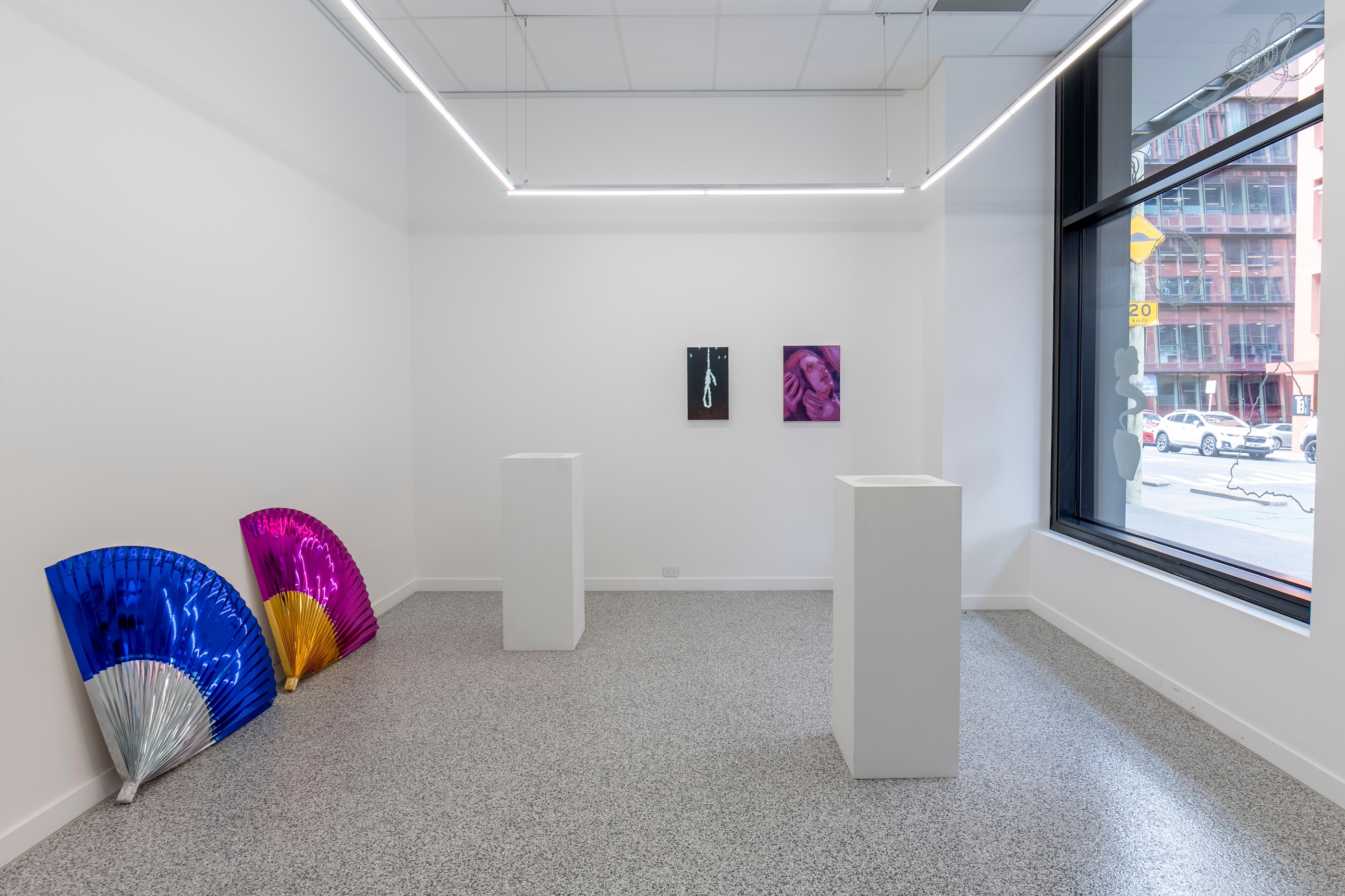
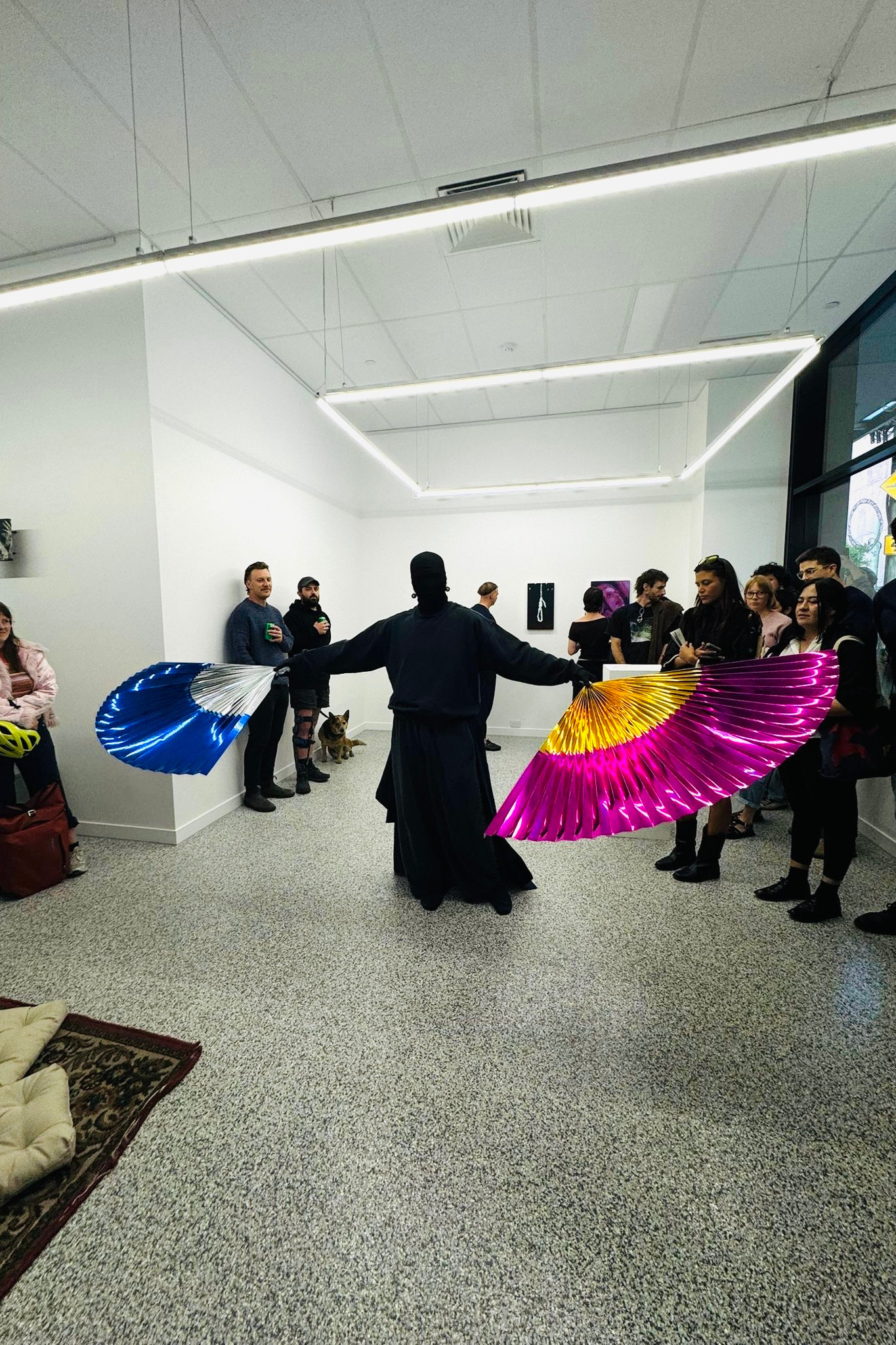
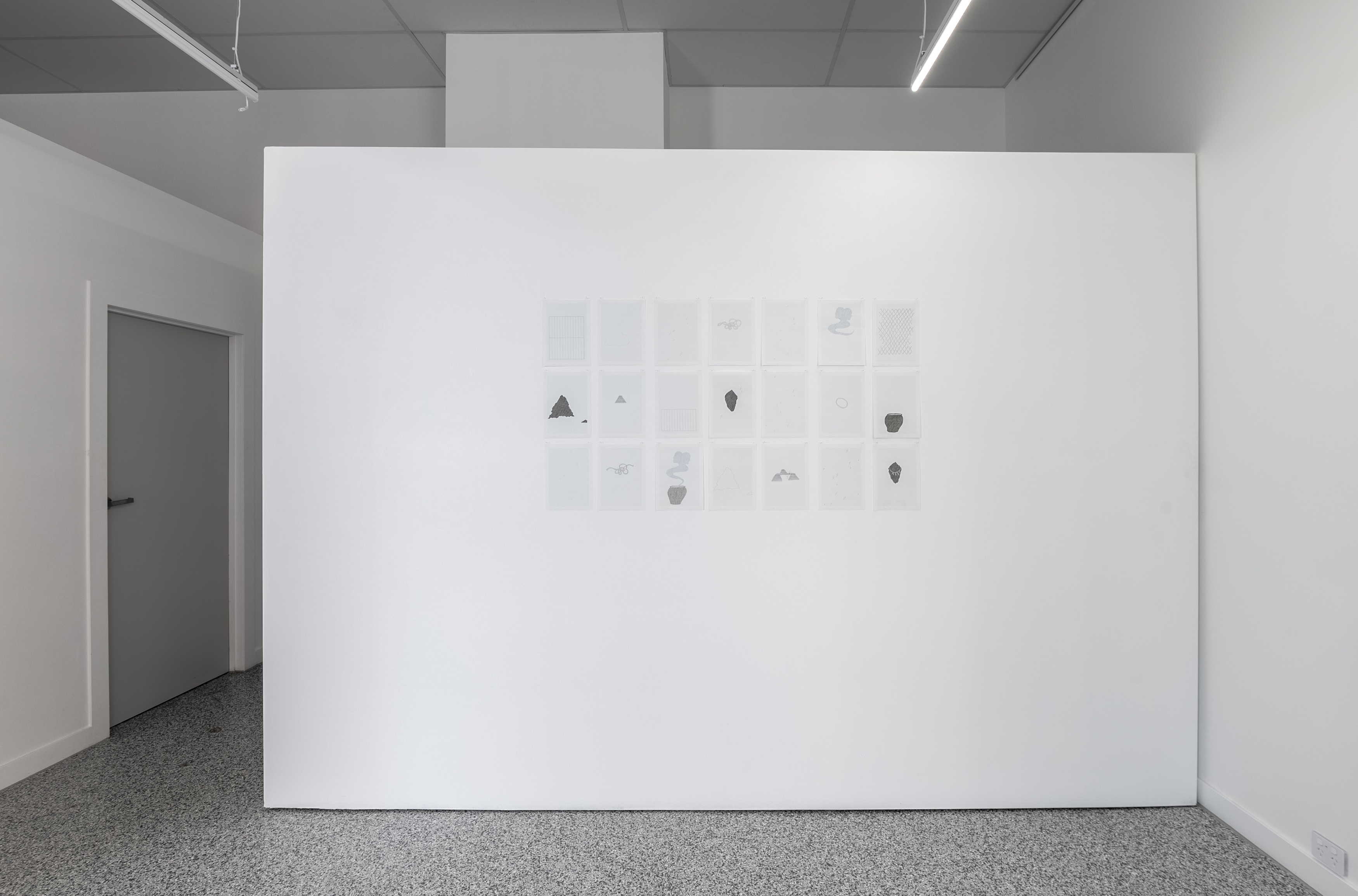
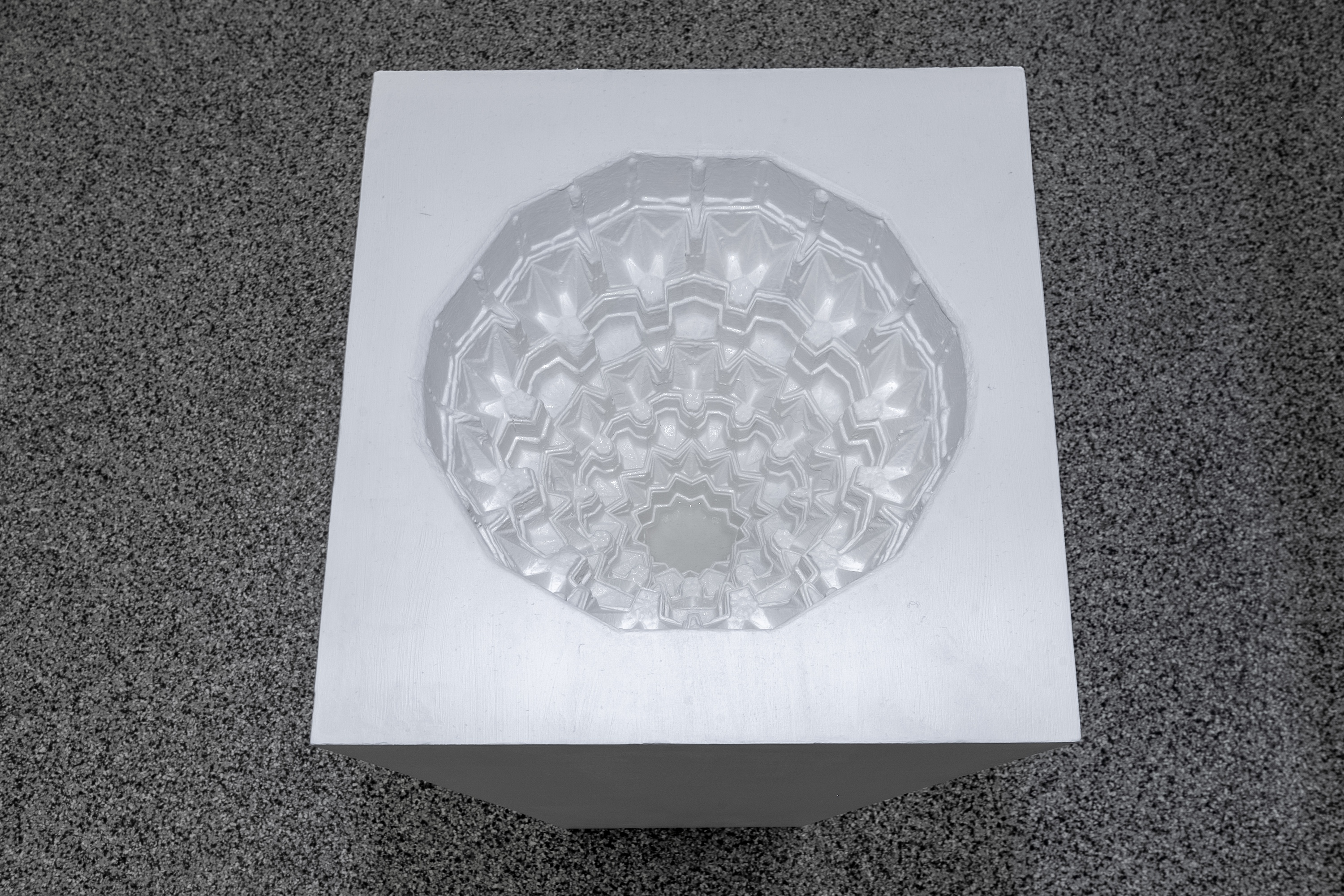
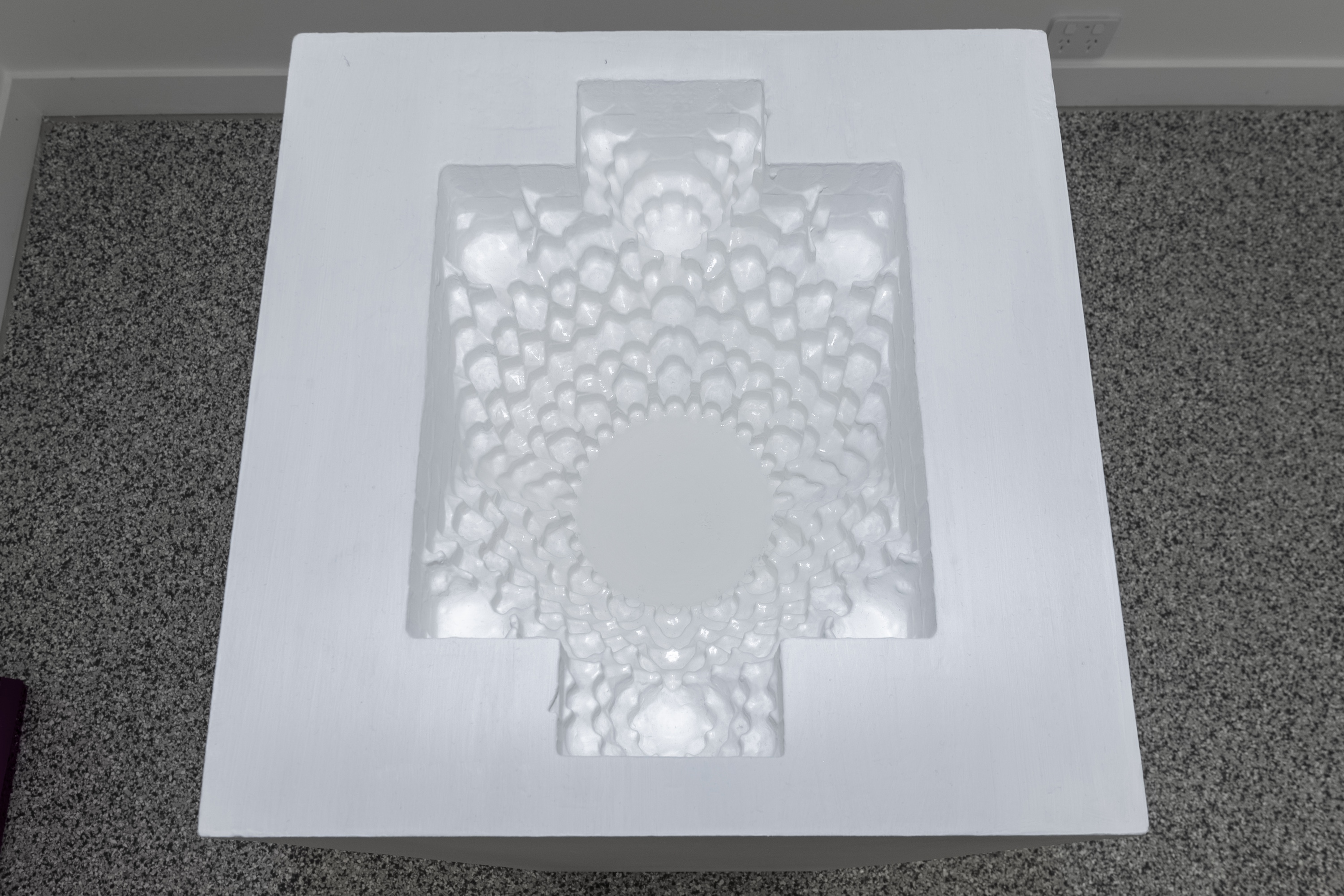

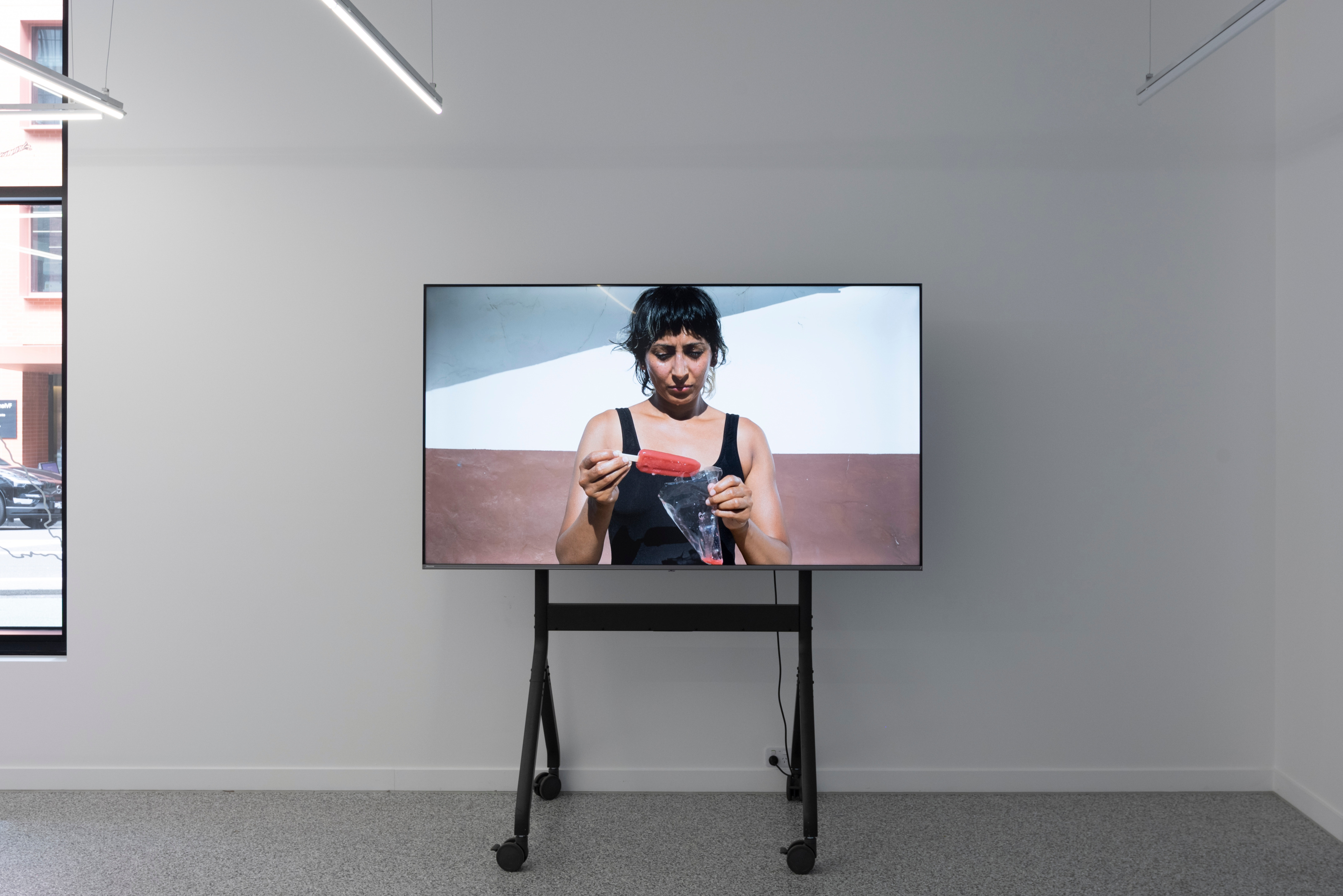
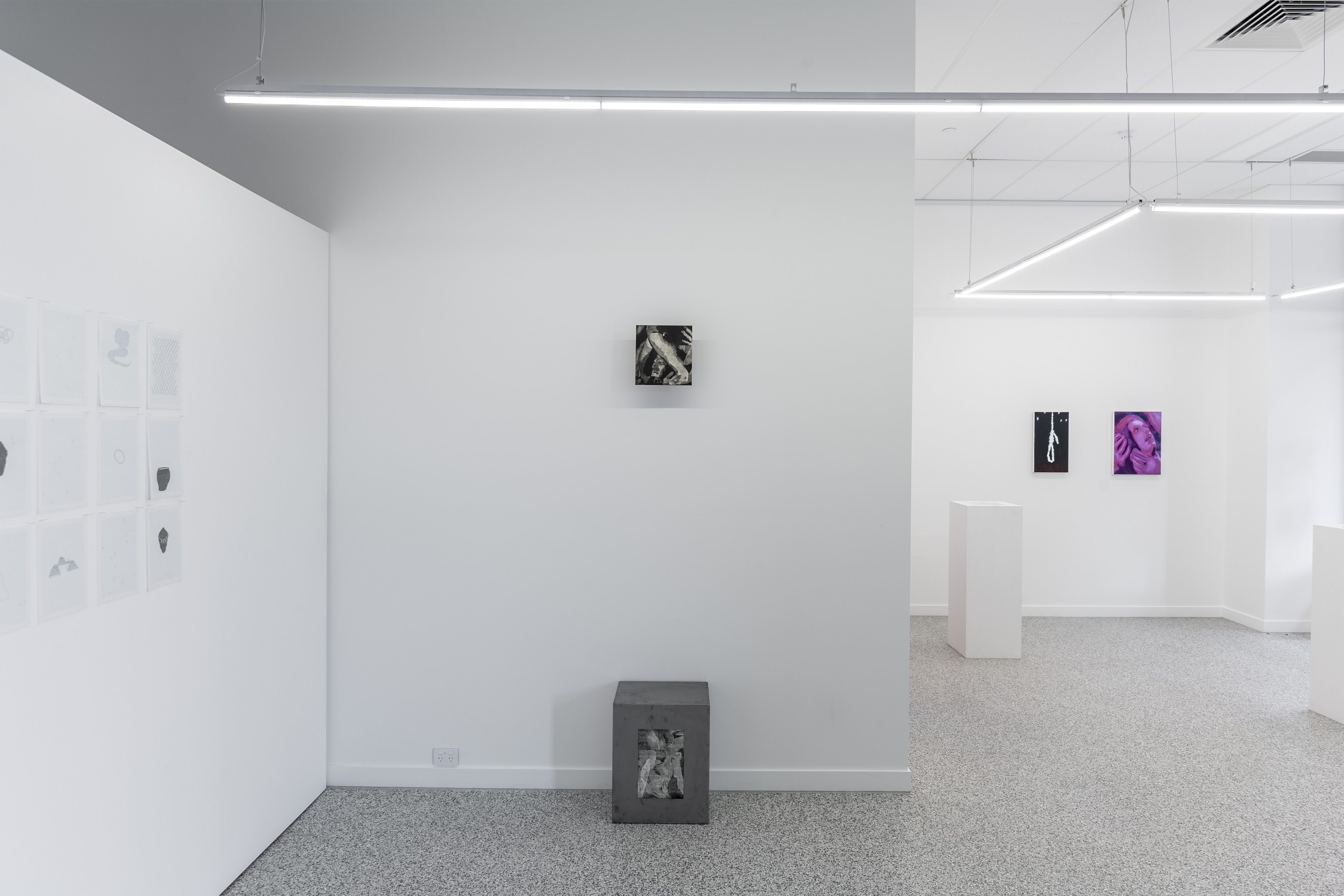

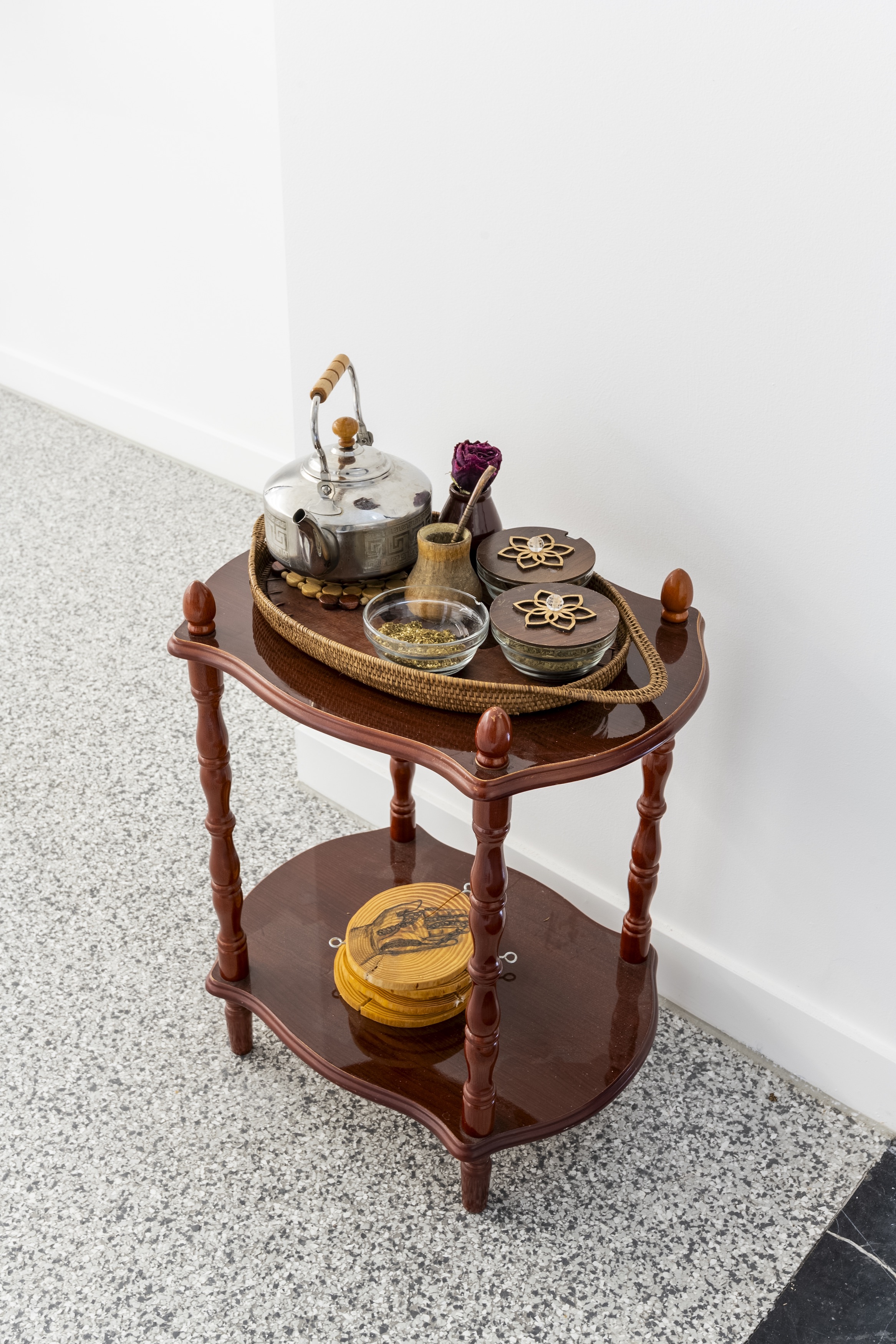
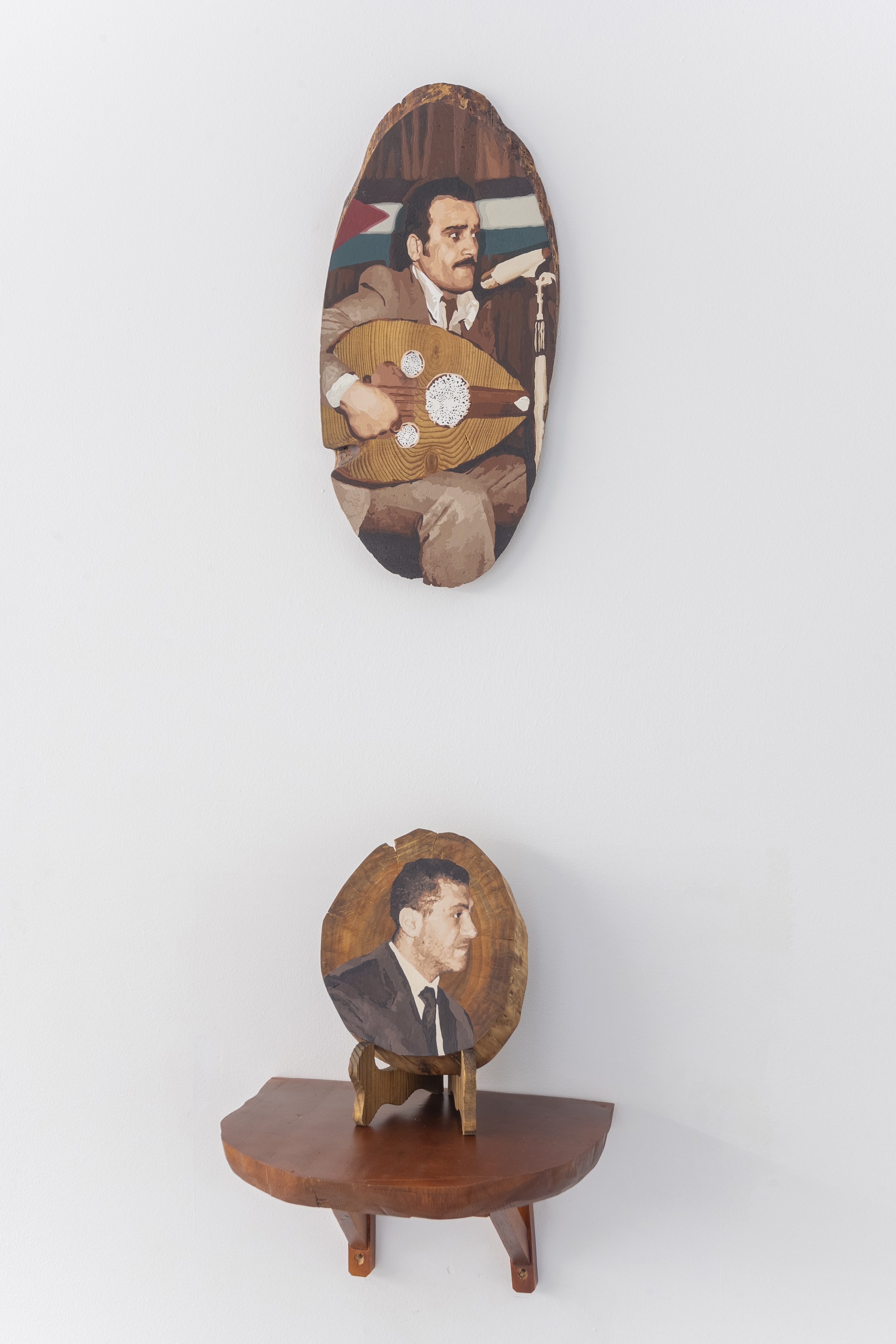
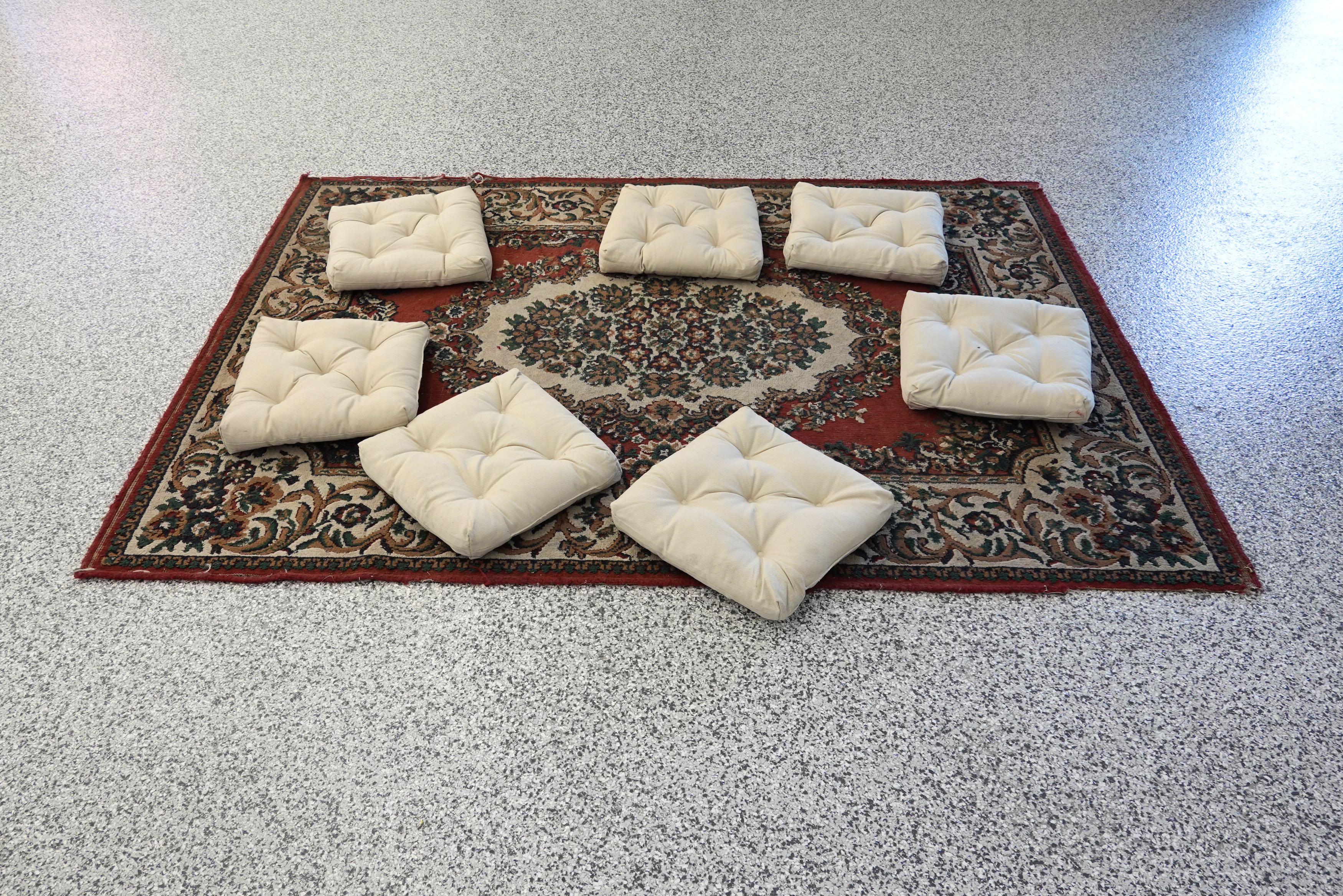

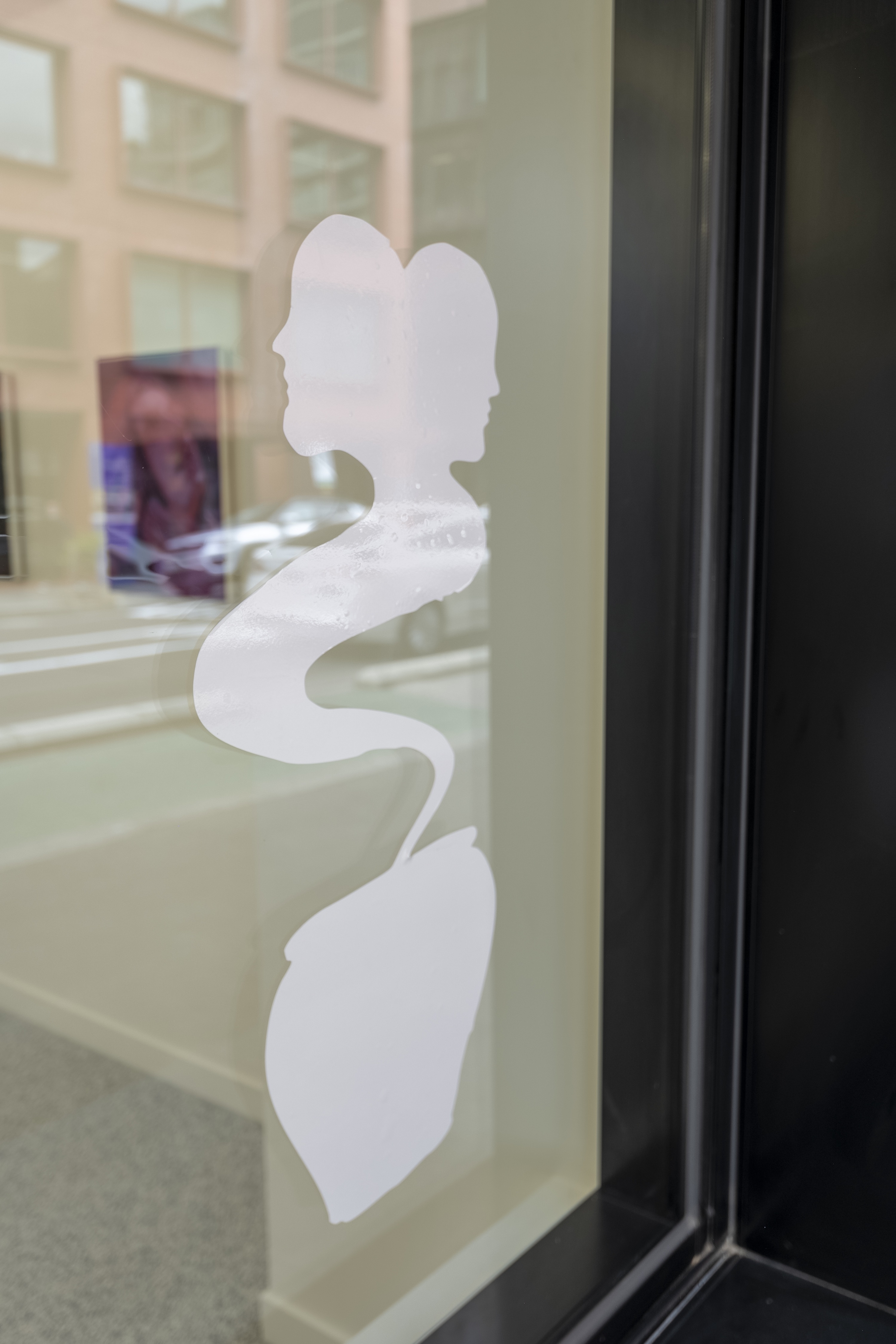
Maki Ogawa
Maki Ogawa is a Japanese–Australian artist based in Eora/Sydney. Working across drawing, painting, and more recently installation, her practice reflects on the ambiguous and shifting nature of bicultural identity. She explores how symbols and motifs - particularly ropes, rocks, and grids -can reveal the tensions and harmonies between cultural frameworks. Through these visual languages, Maki investigates sacred spaces, the role of language, and the interplay between Eastern and Western modes of thinking. Her work embraces hybridity as a generative space, using it to create new ways of understanding and to examine how we navigate, negotiate, and construct our identities.
Naveed Farro
Naveed Farro is an artist-filmmaker who examines how cultural histories are preserved, altered, or lost through displacement, drawing on his perspective as a second-generation Iranian-Australian. His practice employs new imaging technologies to reimagine material cultures and histories, particularly when access to artefacts is limited by conflict and political unrest. His most recent (and ongoinmg) project, The Palace, involves travelling to North Atlantic museums to scan and reproduce plaster cast copies of sculptures from Iranian antiquity at full scale, making them accessible to audiences in Narrm (Melbourne). Through these surrogates, Naveed seeks to restore or reframe histories that have been absent or obscured, while examining the politics of reproduction. He pursues this inquiry through a practice of research, filmmaking, sculpture, and installation.
Naveed's work is part of the State Library of Victoria collection, and he has presented solo exhibitions at MADA Gallery (2025), Bus Projects (2024), Kings Artist Run (2024), the Immigration Museum (2023), and A1 Bakery (2020). He is currently a recipient of the 2026 Expand Lab Moving Image Commission and is a Master of Fine Art graduate at Monash University’s Faculty of Art, Design and Architecture. He has worked as a Moving Image Designer at the National Gallery of Victoria and in post production at VICE Media. He teaches Film and Media Studies at Monash University.
Keiran Molaeb
Keiran Molaeb is a queer Lebanese artist whose practice explores cultural, interpersonal and familial connections. His work seeks to honour memory and celebrate the rich diversity of his heritage, creating a visual language that pays tribute to the people, places and histories that shape his identity.
Working primarily in portraiture, Keiran approaches each painting as a kind of ‘family portrait'. His subjects are chosen with care, selected for the significance they hold in his life, and rendered through a slow, deliberate process that becomes an act of dedication and love.
Rooted in storytelling, his practice explores the idea of ‘cultural roots’, reflecting on how connections stretch, intertwine and persist across borders. His paintings are created on Lebanese cedar and olive wood sourced from his father’s home country and prepared by hand by his grandfather. By grounding each work in this material lineage, Keiran wants to make ensure that every element (medium, subject and process) remains connected to the culture he commemorates and celebrates.
Thang Do
Thang Do is a queer Vietnamese-born artist based in Melbourne whose performances and installations explore humanity’s attraction to spectacle as a way to escape, hope and imagine new possibilities. Drawing on the tensions between Vietnam’s unresolved passages into modernity and the Western pursuit of the “Australian dream,” Thang’s work examines the emotional and cultural negotiations of migrant life.
Using domestic materials such as paper, foil and glitter, Thang creates embellished vessels and altar-like installations that merge spiritual symbolism with bureaucratic realities. Works including Department of 2nd Home Affairs highlight the anxieties and aspirations shaped by visa systems, cultural inheritance and social precarity. Through these hybrid forms, Thang invites viewers into a space where desire, identity and transformation co-exist.
Johanna van der Linden
Johanna van der Linden (she/her) is an artist living and working on unceded Wurundjeri country in Naarm. Her practice spans print making, metalwork, and sculpture, where she reinterprets traditional iconography through a contemporary lens. Johanna explores themes of embodiment, materiality, and the intersections between the body and the material world, engaging with feminist materialisms to examine the relationships between physicality and symbolism. Johanna holds a BA in Creative Arts/Education from Australian Catholic University, a first class Honours in Fine Arts from RMIT University, and a MFA in Sculpture from the University of Canterbury, Aotearoa.
Alexandra Kumala
Alexandra Kumala is a Jakarta-born filmmaker and writer whose work examines the complex layers and intricacies within Indonesian identity. Through film, sound and moving image, she works and plays with nontraditional forms - that excavate silences, explore the language of absence, and discover ways to articulate the many stories that are otherwise untranslatable and inexpressible. Drawing on her multicultural heritage and a life lived across continents, she uses symbolism, metaphor and allegory to examine shifting borders, histories and power. Her films and essays foreground marginalised voices and speak to anyone who has felt silenced, erased or caught between worlds.
Jacob Kotzee
Jacob Kotzee is a Perth-based artist whose painting practice explores the tension between legibility and ambiguity. Reworking film stills, media images and found photographs, Kotzee dissolves familiar motifs to question how national identities and cultural memories are constructed. His paintings suspend recognisable imagery into states of uncertainty, opening space for new interpretations of unresolved histories. Kotzee holds a BFA (Honours, First Class) from Curtin University and has exhibited in solo and group shows across Perth, with an upcoming residency at the Perth Institute of Contemporary Arts.
Devika Bilmoria
Devika Bilimoria is a London-based artist raised in Naarm/Melbourne whose x-disciplinary practice spans performance, dance, video, photography, drawing and installation. Drawing from Bharatanatyam, Odissi, theatre and live art, their work explores queering, time and materiality through South Asian diasporic, queer and ecological perspectives.
They hold a BA from RMIT and First-Class Honours from the Victorian College of the Arts, where they received the Rodger Davies Award for their durational performance Offerings. Their work has been shown at the National Portrait Gallery, Museum of Australian Photography, Dancehouse and internationally, including the Whitechapel Gallery’s London Open Live.
Devika has undertaken residencies with Performance Space and Critical Path (Aus), AADK (Spain) and the Creative Body Institute (USA) and has recently been supported by Creative Australia.